ShrimpTempura

  • Subscribe to our RSS feed.
  • Twitter
  • StumbleUpon
  • Reddit
  • Facebook
  • Digg
Showing posts with label ipswich. Show all posts

Friday, 12 October 2012

Boston Cocktail Summit: Spirit Recommendations

Posted on 01:00 by Unknown
You can't have a conference dedicated to spirits and cocktails unless you provide plenty to taste and drink. At the Boston Cocktail Summit, they certainly provided ample opportunity for tasting and drinking, from some of the seminars to the evening parties. In addition, there was a Craft & Fine Spirits Showcase, separated into a Grand Tasting Room and a Craft Distiller's Hall, where a myriad of spirits and cocktails were presented for sampling.

I spent several hours on Saturday sampling in these two rooms, generally passing on those spirits I already knew, seeking out the different, interesting, unique and unusual. Tasting so many spirits is not an easy task, as even if you spit, you still absorb some of the alcohol. It is more difficult than wine tasting due to the much higher alcohol content of the spirits. Fortunately, both rooms had some snacks to help cleanse your palate and absorb some of the alcohol. Plus, taking a lunch break, a burger and tater tots, helped keep me going for  more tasting in the afternoon.

This is a great time in the spirits world, and there has never been a greater number and diversity of artisan and high-end spirits available. No matter what your preference, you can find plenty to please your palate. And if you are adventurous, you will find much to satisfy you, much to delight and tantalize you. I am going to highlight some of the alcohols which most impressed and excited me, those which intrigued me because of their uniqueness and fine taste. I may follow up on some of these spirits in the future, to gain more information about their creation, and if so, I will report back.


Let me start with some local spirits. I previously toured Turkey Shore Distilleries, sampling three of their rums. At the Summit, they presented their newest offering, which had only been bottled less than a week before. The Old Ipswich Golden Marsh Spiced Rum, a limited edition, is basically a blend of 80% of their White Cap rum and 20% of their Tavern Style Amber with the addition of ten different spices. Master Distiller Evan Parker says, "With the cooler weather, we created a flavor profile that is perfect for those crisp days out and about or for those cold nights by the fire."

The rum presents a bright, golden yellow color and a spicy aroma, which will bring to mind autumn and cool weather. It has a smooth taste, with delicious fall spice notes and hints of orange peel. This is definitely a rum to enjoy now, either on its own or in a cocktail. Evan states, "For a simple, tasty cocktail, you can pair Golden Marsh Spiced Rum with ginger beer or hot cider." I could easily see this rum added to some hot cider.

They also had an intriguing cocktail to taste, which was made from the Golden Marsh Spiced rum, caramel, butterscotch liqueur, and spiced apple cider, topped with a Pumpkin Munchkin. The rum complemented this drink very much and I think apple cider is a great pairing. The guys from Turkey Shore, Mat Perry and Evan Parker have created another winner.

Grand Ten Distilling is another local distillery, located in South Boston, and Luke O'Neil has just written an interesting article in The Phoenix about this distillery. For background on the distillery, you should check out his article though it only discusses their Wire Works Gin (which I did not taste). I tasted three of their other products and found all three to be interesting.

The Amandine Barrel Aged Almond Liqueur spends about 6 months in 30 gallon American oak barrels. They use 30 gallon barrels as it is easier for two people to move them around rather than the usual 53 gallon barrels. The barrels are toasted, not charred, as they do not want the barrels to filter out any of the taste. All the color of liqueur is due to the barrels. The liqueur had a pleasant almond taste, not too sweet, and would make a fine addition to a cocktail. The Angelica Botanical Liqueur is made with angelica root, cinnamon, orange peel and cloves. It too is not sweet, but is aromatic and floral with a fresh, clean taste and slight hints of spice. Another liqueur that would add interesting flavors and aromas to a cocktail. The Fire Puncher Fire Vodka has a hickory smoked and pepper flavor, and I found the peppery notes to be far more prominent than the mild smokiness. It is farily easy drinking and would be great in a Bloody Mary.

Another local company, in Somerville, is Infusion Diabolique which is a collaboration between Executive Chef Robert Fathman and Brandon Bach, both who worked at Azure. They produce infused alcohols and at the Summit showcased two of them, their bourbon and tequila, though it appears they also make an infused rum. They are all infused with natural fruits, herbs and spices.

The Infusion Diabolioque Kentucky uses a four year old bourbon and infuses it with dried organic Black Mission figs, Madagascar & Tahitian vanilla, cinnamon, star anise, black currants, cloves, and allspice. It smells like typical bourbon with subtle spicy notes and on the palate, the bourbon flavor is enhanced by subtle fruit flavors with a pleasant melange of spices. It was smooth and easy drinking, and would satisfy you on its own, though it would do well in a cocktail too. The Infusion Diabolioque Mixto is a silver tequila infused with sweet pineapple, Persian limes, cardamon, and mint. Up front, the usual tequila flavors are most prominent, but it then transforms into a more complex blend with some tropical fruit accents and subtle mint. The finish is smooth and long, with hints of lime. Again, it would work well on its own or in a cocktail.

Dunc's Mill is the oldest continuously operating distillery in Vermont. The founder, Duncan Holaday, previously created Vermont Spirits but now has moved on to creating local rum. He currently produces two rums, both which are made from Fair Trade, organic sugar cane and Vermont flavors. The Elderflower Flavored Rum is created with Vermont elderflower blossoms and Austrian elder essence, which is infused into a light rum. I was impressed with this rum, which possessed a delightful floral aroma, and on the palate was smooth, clean and dry with a prominent, but not overwhelming, taste of elderflower. It was a well balanced spirit which reminded me somewhat of a dry version of St. Germain Elderflower Liqueur. I am not a huge fan of maple flavor but their Maple Flavored Rum, made from Vermont maple syrup, was pleasant. It was dry and possessed a milder maple profile, once again also smooth and clean. Another well balanced spirit, you should check out both these rums.

In 2006, the Consejo Regulador Del Tequila (CRT), the ruling tequila body in Mexico, added a couple new tequila categories: Extra Anejo and Infused Blanco Tequila. Tanteo has taken advantage ot the later of the two categories and currently produces three Infused 100% De Agave Tequilas ($36-$40). Their inspiration was the fruit cups, topped with chiles, they found in Mexico. Their blanco tequilas, Jalapeno, Cocoa and Tropical, are infused with natural ingredients, such as organic jalapenos.

Their Jalapeno was my favorite of the three, and it is produced by infusing organic jalapenos, hand-sliced, which are mixed in a 10,000 gallon tank with the tequila. On the nose, there is some grassy notes as well as the typical agave, and on the palate, the tequila flavor was very prominent up front. On the finish, rather than the usual tequila bite, you ended up with a spicy and delicious jalapeno burn. It was not overly spicy, but very noticeable and I loved that heat. I could easily enjoy this on its own though it would make great cocktails as well.

The Cocoa is made with roasted, malted and raw cocoa, like a traditional mole, and has a little jalapeno added as well. It presented a strong cocoa flavor atop the tequila notes, a strange combo that actually worked, and certainly was intriguing, though not my personal preference for a spirit. Yet I could see it working well in the right cocktail. The only issue is that I didn't get much of a jalapeno kick to this tequila. The Tropical is infused with pineapple, mango, and guanabana, also known as soursop, and there was a little jalapeno added too. The tropical fruits added subtle flavors, enhancing the tequila, though again the jalapeno wasn't really assertive. I could see this tequila working well in a tropical cocktail.

The Macchu Pisco La Diablada is intended to be a high-end Peruvian Pisco and is currently not available in the U.S. but that will hopefully change soon. They only make 1000 bottles so even when it becomes available, it will be in very limited supply. La Diablada is a blend of 3 Pisco grapes: Quebranta, Moscatel and Italia. It is rested, not aged, for about 18 months and sees no oak. It is very aromatic with a smooth taste of herbs and fruit, with some underlying spiciness. A complex taste with a lengthy and pleasing finish. Though many know of the Pisco Sour, this is a Pisco that you might want to enjoy on its own, rather than as the base for a cocktail.

I love a good bourbon and the Rock Hill Farms Bourbon, produced at Buffalo Trace, really excited my palate. It is a single barrel, Kentucky Straight bourbon that is 100 proof, though you probably won't notice the alcohol is that high. It is an excellent sipping bourbon, smooth, complex and absolutely delicious with nice vanilla notes and intriguing spicy elements on the finish. This is definitely a bourbon I will add to my home bar.

Brendan Edwards of Third Wave Brands, a supplier of spirits and wines, presented several different brands (including Montanya Distillers, Delirio de Oaxaca, and Cariel Vodka) and I found them compelling.

Montanya Distillers, owned by Karen & Brice Hoskin, was founded in 2008 and is now located in Crested Butte, Colorado. which is is the West Elk Mountain range of southwest Colorado. They currently produce two rums, the Platino Light Rum and Oro Dark Rum. The rums are all natural, each made with only four ingredients, including water, sugar cane, yeast and honey. The water comes from Colorado mountain springs while the sugar cane is from Maui, Hawaii. At the time of bottling, a tiny bit of Colorado mountain honey is added to the rum.

The Oro is aged in a fresh, American oak whiskey barrel that previously held Stranahan's Colorado Whiskey. The Oro was a fine sipping rum, with a pleasant blend of flavors, including vanilla, honey, caramel, and mocha hints. I really enjoyed it and would drink it both straight or in a cocktail. The Platino is aged in a barrel that once aged Oro, so the barrel has far less effect on the rum. The Platino is also filtered and I found it to be very aromatic, a lighter rum with vanilla and herbal notes. For me, it would be best used in a cocktail.

Delirio de Oaxaca is a traditional palenque in Matatlan, Oaxaca, producing Mezcal by Master Distiller Fernando Santibanez. The Mezcal Joven is double distilled in copper alembics from 100% Agave Espadin and only 10,000 bottles were produced. It had an intriguing smoky nose with a prominent taste of agave fruit and a mild smokiness. Quite tasty and I could drink it on its own or in a cocktail. The Mezcal Reposado has been aged for about 4 months in lightly toasted American oak and only 5000 bottles were produced. It had a lighter nose of smoke, and on the palate it was softer and more subtle, with the same delicious fruit flavors and hints of smoke. Again, another winner.

Cariel Vodka was created by Master Blender Peter Carlson in Sweden, who desired to create a vodka with natural flavor and the product just came on the U.S. market in July. It is produced from Swedish winter wheat and barley, as well as glacial water from Lake Vattern. I found the vodka to have an almost subtle sweetness to the aroma, with an intriguing and smooth taste, elements of herbs, grain, and subtle peach flavors. It is definitely not a tasteless vodka but rather presents an enticing melange of subtle tastes. I was impressed. They also produce a Vanilla Vodka, made with the addition of vanilla from Southern India and Madagascar. It had a big, bold vanilla aroma and flavor, yet it remains only mildly sweet, not cloying like many other flavored vodkas. I can see this working well in the right cocktail.

Koval Distillery, founded in 2008, was the first craft distillery in Chicago since Prohibition. The founders, Robert and Sonat Birnecker, gave up their academic careers to create the distillery. Using custom-made Kothe potsills, they produce organic and kosher liqueurs and whiskey. The whiskey is made in small batches from 100% Midwest organic grain from Midwest and aged in 30 gallon organic oak from a Minnesota cooperage.

My favorite of the three I tasted was the Lion's Pride Dark Rye, made from 100% Rye. It presented nice vanilla and bold spice flavors with hints of citrus. A nice sipping whiskey. The Lion's Pride Dark Millet had a more earthy flavor with vanilla accents. The Lion's Pride 47th Ward is made from a mash bill of rye, wheat, oat and malted barley, and is aged in heavily charred oak. Each grain is distilled separately. This is a complex and spicy whiskey, but at 94 proof, you probably need to add a little water to mute some of the alcoholic heat.


In general, I am not much of a Gin guy because I find too many gins with a strong juniper taste. But, I have found myself enjoying much more the ancestor to gin, Genever, which is made with numerous botanicals and where any juniper flavor is far more subtle. Veronique Beittel is the owner of Flemish Lion, an importing company, based in Vermont, of Belgium Genever. She even has an informative website of information about Genever. At the Summit, she was showcasing two Genevers from Diep9.

The Diep Young Genever is distilled using 19th century techniques, hand crafted in a traditional copper pot at De Moor, Belgium's smallest family owned distillery. It is produced with a combination of rye, wheat, malted barley, and nine botanicals. Those botanicals include juniper berries, sweet orange peel, blessed thistle, carob, nutmeg, guinea pepper, angelica root, cinnamon and coriander. I liked the herbal blend on this spirit, which was relatively smooth and easy drinking. I think the key was the balance of the botanicals, that none of them seemed to overpower the others. The Diep9 Old Genever is distilled using 16th century techniques and is barrel aged for two years in French oak. It is also packaged in an old style clay bottle. Though it too has a balanced, herbal taste there is also a deeper, earthier element, which really intrigued me. Try these Genevers and let them open your eyes to the possibilities.

Palm Bay International is a distributor of wines and spirits and they showcased several of their products at the Summit, from mezcal to whiskey.

Los Amantes, which translates as "the lovers" and is inspired by an ancient Aztec legend, produces Mezcal  made of 100% agave from Oaxaca. Only a small supply of this traditionally produced spirit is available in the U.S. The Joven has about 2 months of barrel aging and the nose had a mild smokiness with a bit of brininess as well. On the palate, it was smokier, with strong fruit flavors and a nice smoothness to the finish. Delicious and easy drinking. The Reposado has been aged for about 6 months in American oak and its taste was superb, a complex melange of flavors, smokiness and subtle accents of fruit. An excellent sipping spirit, it is highly recommended.

The Bastille 1789 is a French blended whisky hand-crafted in the Cognac region and produced from barley and wheat grown in northeast France. Their water derives from the Gensac Spring and it is naturally filtered through limestone. It has been finished in French Limousin oak casks. It was an intriguing whiskey, with a complex blend of flavors, with orange notes, dried fruits, honey and Christmas spices. There was a mild earthy backbone, and it was smooth and easy drinking with a satisfying finish.

The Irishman, founded in 1999 by Bernard and Rosemary Walsh, produce a line of Irish whiskey based products. The Original Clan is a pot still blend of 70% single malt and 30% pure pot still. It was triple distilled and matured in bourbon casks. This was produced in a pre-Prohibition style and is said be be a "gateway" Irish whiskey. This is a delightful sipping whiskey, with delicious flavors of caramel, honey, vanilla and butterscotch as well as slight undertones of pepper and spice. It goes down so easy and lingers in your mouth for a long time. I can understand why so many people will enjoy this whiskey.

The Single Malt is produced from 100% malted barley, was triple distilled and then matured in first-fill bourbon and sherry oak casks. Only 1000 cases of this whiskey were made. This is a more serious whiskey, being complex, subtle and intriguing. There is less sweetness than the Original Clan and a bit more spice, and the finish is even longer and more pleasing. This is definitely a whiskey to slowly sip and savor, and will appeal to whiskey aficionados.

The Superior Irish Cream is a blend of real Irish cream and 100% Irish whiskey, with added hints of vanilla and toffee. All of the ingredients are natural and it does not contain any thickening agents or artificial ingredients. It is based on an old family recipe and was a satisfying pleasure. There is a thick, creaminess to the drink and the whiskey flavors are not hidden in the least. It does not taste artificial in any way, and with winter approaching, you might want to stock up on a couple bottles for those chilly evenings. Add a bit to your coffee or tea, or just drink it on its own.
Read More
Posted in Boston, bourbon, cocktails, colorado, conference, distillery, gin, ipswich, kentucky, liqueur, Massachusetts, mezcal, pisco, rum, Somerville, spirits, tequila, vermont, vodka, whiskey | No comments

Tuesday, 6 March 2012

Andrew Cabot of Privateer Rum: History, Cheese & Jazz

Posted on 01:00 by Unknown
Sipping a Guinness, Andrew Cabot's eyes lit with intensity as he related the role of privateers during the Revolutionary War. That intensity, that passion, was evident throughout our conversation, and it was not restricted to history.

On my recent visit to Privateer Rum, I did not get to meet owner Andrew Cabot but he contacted me after my article was posted. We agreed to meet for a drink, to further discuss his company and its rum, to get deeper into his underlying philosophy, and last Friday we met at The Sevens on Charles Street in Boston. Andrew is a fascinating man, and we found that we shared a number of passions, from history to cheese, as well as philosophical positions on a number of topics. From the role of wine scores to the type of meals that Andrew prepared at home, our discussion ranged across many topics, though rum was the primary focus.

Andrew's goal is to transform Privateer Rum from its currently small, local basis into a national brand. Yet he also desires to maintain high standards for his products, to create a quality rum which is unlike any other on the market. He believes that many rums on the market don't measure up to other spirits such as whiskey and brandy, and there is much truth in that regard. Though many people might enjoy a glass of fine whiskey several times a week, most would not do the same with rum. It sometimes seems like one of the lesser spirits, not as popular as it could or should be.

So Andrew's intention is to produce a rum that is far more enticing, which can stand proudly against any other spirit. He desires to create a rum that is inspired by other spirits but which still retains the essence of rum, possibly redefining the usual definition of rum. Andrew's palate is very sensitive to sugars, so he doesn't like rums that are syrupy, or have a dominant molasses taste. Thus, in his own rums, he tries to reduce the use of molasses to avoid that overly sweet flavor. In addition, he seeks a purity in his rums, so he won't adulterate his rums and tries to avoid manipulation. As an example, this means, despite its historical roots, he won't create a spiced rum.

In a slight correction to what I was told at the distillery, they do not use only Hungarian oak, but also avail themselves of French and American oak. They continually experiment with oak treatment, refining and revising their production to produce the flavor profile they desire. Andrew does not generally believe in the use of small barrels, and this belief has been supported by a number of master distillers. Andrew stated that "you can't buy time" and that the increased surface area of the rum that interacts with the oak concentrates the flavors too much.

Andrew does not desire to create a rum that is only sippable on its own, and cannot be mixed in a cocktail, but rather wants to create a more versatile product. He believes rum should be fun, and that consumers should be free to use his rum in any manner they choose, whether sipping it straight or blending into a cocktail. Rum should not be a pretentious drink, and Andrew tries to avoid making it so, an admirable goal. He enjoys connecting with consumers, meeting them and trying to engage them in conversation. To him, it can be a learning process, not only for consumers but also for himself. I found Andrew to be very down to earth, and lacking in pretension, and feel he is a persuasive advocate for his rums.

Though rum was the primary focus, Andrew's words on other topics also told me much about the man. Preparing a medieval dinner for his children, transforming a meal into a greater experience. The simple pleasure of visiting Paris, purchasing cheese from a local shop and enjoying it while sitting on a bridge. His difficulty in selecting his favorite local restaurant. His joy at watching a chef prepare a meal with some extraneous ingredient, or improvising because of the lack of an important one. His obvious affection for jazz, and how it relates to many topics. This is a man of many passions.

So check out Privateer Rum, and if you can, chat with Andrew. I am sure he would love to interact with you, to discuss his rum and so much more.
Read More
Posted in cheese, cocktails, distillery, history, ipswich, rum, spirits | No comments

Tuesday, 28 February 2012

Turkey Shore Distilleries: Rum With A Sense of History

Posted on 01:00 by Unknown
Could there be a historical connection between Privateer Rum and Turkey Shore Distilleries? Could the historic individuals, Andrew Cabot and John Heard, who inspired these new rum distilleries been involved together in privateering? This is a fascinating historical puzzle, one I would like to further explore in the near future.

On the same day that I toured Privateer Rum, I also visited Turkey Shore Distilleries, another new rum distillery in Ipswich. Turkey Shore was founded in 2010 by two childhood friends, Evan Parker (pictured on the left) and Mat Perry (pictured on the right). Mat is a former high school history teacher and Evan, who works as their Master Distiller, is enamored with history as well. This strong passion for history is a primary component of their distillery, and touched upon my own love for history. While engaged in local research, they realized they had a personal connection to a rum distillery from colonial times.

Evan and Mat both grew up on Turkey Shore Road in Ipswich, which once was the site of a rum distillery. In 1765, William Story Sr. purchased a plot of land on Turkey Shore Road and soon after constructed a rum distillery. On May 1, 1770, William then sold the land and distillery, in equal shares, to his son, William Story, Jr. and John Heard, though sometime soon after, Heard would acquire full title to the  property and distillery, which would continue to operate until 1836.

Along the nearby Ipswich River, there was a wharf, once known as Dodge's Wharf though which later took on the name of Hunt's Wharf, which was a port for ships importing molasses and other goods. Hunt's Wharf was located in what is now Mat's back yard. The molasses would be unloaded from the ships and then rolled across the street to Heard's distillery. In addition, the distillery manager was Nathaniel Heard, who once lived in Mat’s house. Between 1795 and 1800, John Heard built himself a mansion, which still exists and is now a museum and the offices of the Ipswich Historical Society. In February 1818, John Heard transferred ownership of the distillery to his son, George Heard.

As I mentioned previously, Andrew Cabot once owned a rum distillery in Beverly, so it is likely his company was a competitor to John Heard's distillery in Ipswich. Being engaged in the same business, it seems likely they knew each other. What really intrigues me though is the question whether these two men had a privateering connection or not. During the Revolutionary War, Andrew Cabot became a privateer, plying the waters against the British while John Heard financed a number of privateers. Did Heard help to finance Cabot's privateering efforts? I don't know right now but it is worth some additional research.

Mat and Evan desire to create affordable, artisan rum in an old New England style, and they did plenty of historical research on rum production, which is reflected in much they do. They also follow a compelling philosophy of using local when available, and then sourcing domestic as a back-up. About the only item they use which is not local or domestic are their bottles, which are produced in Germany.

Pictured above, the large white tank is for their molasses, which is table-grade rather than low quality blackstrap molasses. Pursuant to their philosophy, the molasses is not sourced from the Caribbean, but is more domestic, usually from Louisiana or sometimes Florida.

Turkey Shore has four 500 gallon, open top fermenters and each one is named after one of the original owners, John Heard and William Story Jr., and their sons. An open top fermenter is very traditional, and it is also supposed to be easier to use and easier to clean. Usually, they mix into the fermenter about 75-100 gallons of molasses with 400 gallons of water and this mixture ferments for about 12 days. That results in a "molasses beer" with an alcohol content of 9-12%.

Above, you can see that "molasses beer" which has almost completed its fermentation. The picture also shows wires that sticking down into the mixture and they are used to provide heat to the interior of the fermenting liquid. That is necessary as they are using a Rhum Agricole-style yeast which requires the heat throughout the mixture, and without the wires extending through this large tank, the yeast might stall and prevent proper fermentation.

After more research into the type of rum they wished to produce, Mat and Evan had a 250-gallon copper pot  still custom-built by Vendome Copper & Brass Works in Kentucky. They use only a pot still, not column distillation, and there is no automation involved. Everything is assessed by taste and feel, providing a more artisan product. In addition, this is more of a traditional method, rather than the heavily automated processes found in some large, commercial distilleries.

The two barrels, pictured above, have seen quite a journey, starting out in Spain where they were used to age sherry. In time, those barrels then traveled to Scotland, to be used for Macallan Scotch. Eventually, the barrels were transported to Massachusetts where they were first used by Samuel Adams Brewery and then by the Ipswich Ale Brewery.  Finally, they came to Turkey Shore Disillery, where they are primarily decorative, the housing for distilling equipment. But what a history those barrels possess.

The first barrel holds the condenser while the second barrel contains a retort, which allows them to distill to high alcohol while still retaining flavor. They normally conduct 3 distillations, including the stripping run, spirit run and then the retort.

After distillation, their white rum gets blended with redistilled water to reduce it down to about 90 proof and then it is run through charcoal filters, those thin pipes on the right in the photo, to strip off its rough edges, the cheaper alcohols. Then, it can be bottled.

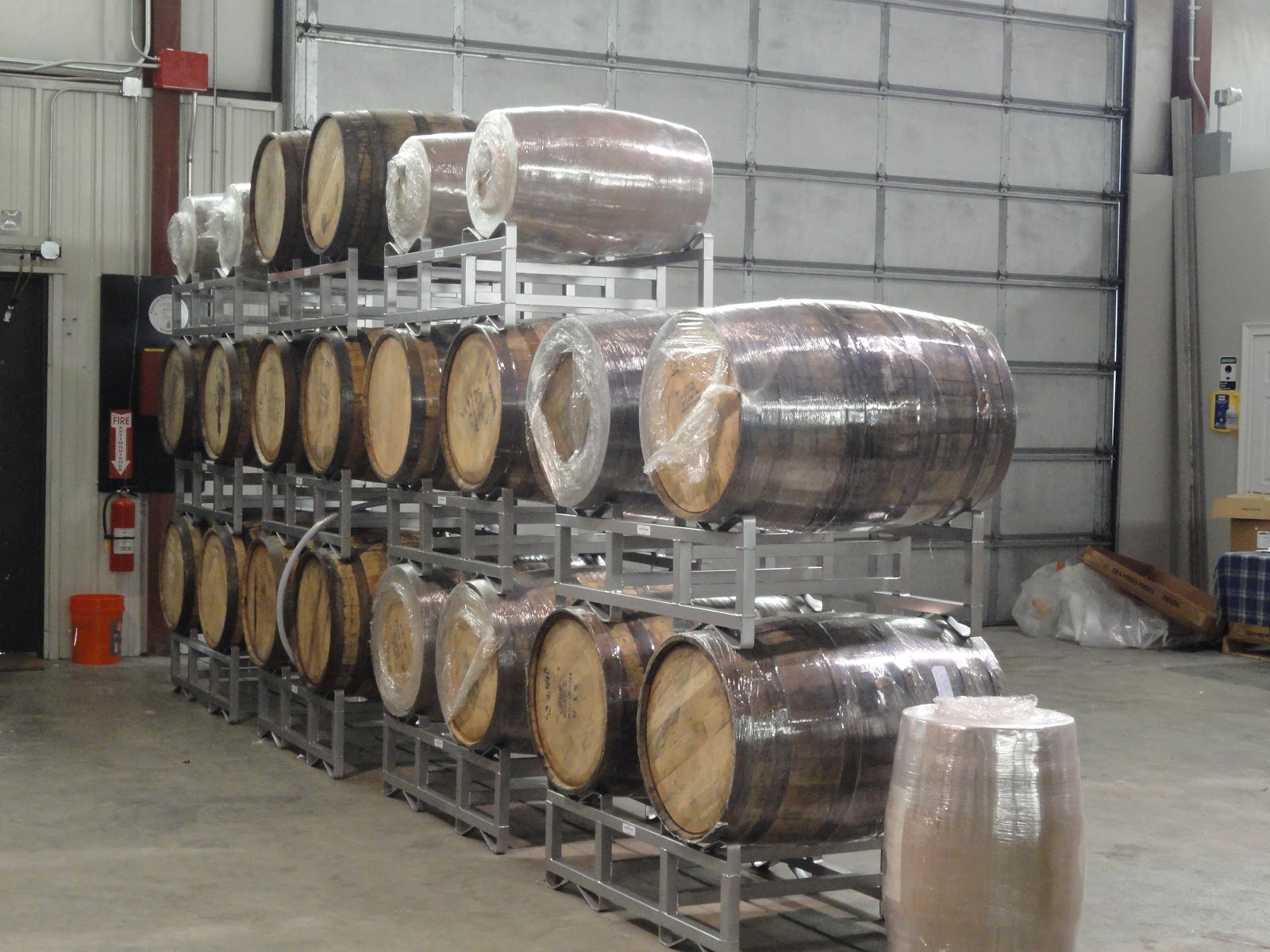
Their amber rum undergoes barrel aging in mostly new American oak, from northern Minnesota, with a medium char. They own about 100 barrels, using 15 gallon and 5 gallon casks, feeling that the smaller barrels give better oak notes in a shorter time period.  About 30 of their 15 gallon barrels are currently full of aging rum. Their 5 gallon casks are new and first use oak, and primarily used to produce special edition rums or be part of their consumer by the barrel program. The main problem with these 5 gallon barrels is that there is a greater amount of "angel's share," that amount of rum lost to evaporation during aging.

The amber rum is a blend, and they do all of their own blending rather than hiring an outside expert. This is another element of their artisan focus, doing as much in-house as possible. They feel that their amber rum drinks more like a whiskey with rum flavors.

Turkey Shore currently produces two rums, a white and amber, respectively named Old Ipswich White Cap Rum and Old Ipswich Tavern Style Amber. In addition, probably in May, they will release a third product, a spiced rum called Old Ipswich Green Head Rum.They try to get local artists to design the paintings on their labels. Both their white and amber rums were originally designed to be used for mixing in cocktails, but they are also sippable on their own. Mat and Evan led me through a tasting of their three rums.

The Old Ipswich White Cap Rum ($21-$23) is named "for the tempestuous seas that define New England coastal living."  This white rum has a mellow aroma, subtle floral notes with touches of herbs. On the palate, it is relatively smooth, with a little bite on the finish, and mild flavors of vanilla and herbs. Though you could sip this on its own, my personal preference would be to mix it in a cocktail. It is far superior to many of the big commercial white rums out there, such as Bacardi.

The Old Ipswich Tavern Style Amber (about $26) spends about six months in a 15 gallon cask, and they wax dip the end of the bottle neck. I was really enamored with this rum, which had plenty of complexity and depth, and interesting flavors of vanilla, caramel, butterscotch, herbs and a subtle smoky aspect. It actually did remind me of a whiskey in some regards, and I would certainly drink this on its own rather than mix into a cocktail. The smaller casks seem to provide more depth to the rum, in a shorter time period, than does a larger cask as is used at Privateer Rum. This Tavern Style Amber is highly recommended.

In their researches, Mat and Evan found many historical recipes for spiced rums so they decided to produce some special editions of their own, using local ingredients as best as possible. Their Old Ipswich Green Head Rum (likely around $23-$25) is their first spiced rum and has been created with lemongrass, green tea, and spearmint. Its aroma is strong with the spearmint and on the palate it is very herbal, with a backbone of green tea, and presents a very unique taste. For my own personal tastes, I would not drink it on its own but it could form the basis for some interesting cocktails. I look forward though to future spiced rums they develop.

Currently, Turkey Shore has about 100-110 accounts, a rough 50/50 split between restaurants and wine/liquor stores, and mostly on the North Shore though they have started making some inroads into Boston. They recently partnered with Burke Distributing Corp., a full service beverage distributor, to spread their rums to Boston and southern Massachusetts, so you should soon start seeing their products in a number of local liquor stores and restaurants.

Turkey Shore is located next to the Ipswich Brewery, which will be moving in a few months and then Turkey Shore will expand into their space, giving them much more room. They also hope to partner with Ipswich Brewery to produce a whiskey, using grain grown within 5 miles of the distillery.  Ipswich Brewery owns some nearby farms, and they would supply the grain to Turkey Shore for the whiskey. Turkey Shore also plans to create some different styles of rum and well as more spiced rum.

Like Privateer Rum, Turkey Shore is still a new company, continuing to learn and refine their products, but has already done well and has much potential. Mat and Evan have a true passion and it can be infectious, and I love the fact that they have great respect for the history of rum, including local history. They produce a very artisan product, with primarily local and domestic ingredients, and that is very appealing. Their Tavern Style Amber is an excellent product and I strongly urge you to check it out. If you are in Ipswich, stop by for a tour and tasting. If not, look for their products at local restaurants and wine/liquor stores.
Read More
Posted in cocktails, distillery, ipswich, rum, spirits | No comments

Friday, 24 February 2012

Privateer Rum: Silver Reserve to True American

Posted on 01:00 by Unknown
In many respects, a privateer was simply a legal pirate, and an enemy would not even accept the validity of their legality. Privateers received letters of marque from a government, granting them the right to attack foreign ships, and they were frequently used during the 16th-19th centuries. During the Revolutionary War, American privateers plied the waters, attacking British ships, and one of those privateers was Andrew Cabot. Six generations later, his descendant and namesake, Andrew Cabot, is honoring this history with the creation of Privateer Rum.

About five years ago, Andrew Cabot discovered the history of his ancestor, and also learned that the original Andrew Cabot had operated a rum distillery in Beverly, Massachusetts. This inspired Andrew, and with his partner Nelse Clark, they started a rum distillery in Ipswich. Recently, I toured their facility, getting to meet Nelse and Jeff Murphy, their Head Distiller, and tasted their two products.

The distillery, which opened last year, is nestled in a warehouse within an industrial area of Ipswich, a short distance from the Clam Box. Cabot and Clark initially hired Eric Watson, a Master Distiller from West Virginia, to design their facility and create the basic recipes for their rum. Since then, Jeff Murphy has been refining those basic recipes, so they can produce a unique product. Jeff has a background in commercial brewing, having spent a couple years in Singapore and then a number of years in San Antonio, Texas, making vodka and whiskey. Jeff explained to me how they made the rum, answering all of my questions.

In making rum, obviously the most important ingredients are the sugar products that are used, most rums being produced from molasses. There are three basic quality levels of molasses, the lowest being blackstrap. Privateer does not use blackstrap in their rums, preferring a higher quality molasses, and obtain their sugars and molasses from AmCane Sugar, LLC., most which seems to originate from the Caribbean. In addition, not all of their rums use molasses.

They currently have two fermenters, pictured above, which each hold 15 barrels, and they will soon obtain a third fermenter, which will be twice as large. They typically ferment their product for about six days, creating a mixture that is about 8% alcohol. The alcohol will then be stripped out and the mixture will next go be placed into the pot still.

Privateer uses both a pot still and column still to produce their rums. First, the mixture is put into the pot still until it reaches about 40% alcohol when it is then put through column distillation, which will create a liquid that is 40%-90% alcohol. Next, that portion of the rum which is designated to become white rum will be placed into stainless steel tanks for a time until bottling. It takes about eight weeks for their white rum to go from column distillation to bottling.

The portion of their rum that will become amber rum will undergo oak aging, starting with a period of about 6-8 weeks in Hungarian oak. They use new charred barrels, most with a medium toast and medium char, though they have some with a medium toast and heavy char. After some experimentation, they discovered that Hungarian oak gave their rum the specific flavor profile that they desired. After that time, the rum will then be placed into used Bourbon American oak barrels. Their amber rum ages for approximately four months, though they are aging a small portion for much longer. At the moment, they possess about 25-30 barrels which contain aging rum.

Their amber rum is a blend, and Privateer hires Nancy Fraley, the Director of Research at the American Distilling Institute in San Francisco, to blend their rum for them. Above, you can see a small portion of the sample bottles that Nancy uses to create a blend, indicative of the complexity of the process. Though the amber rum will be essentially similar from batch to batch, there will be some minor flavor variation as this type of artisan blending is far from an exact science. The first two production runs of the amber rum were only about 100 cases each.

Jeff believes that the specific sugars, amount of aging and type of oak that they use makes their rum more unique than other rums on the market. Their rums generally have light rum flavors, as they do not rely on as much molasses as other distilleries use. Jeff also told me that there is really no tough part of his job, and his enthusiasm and passion for his work and rum was quite evident.

Privateer currently produces two rums, a white and amber, respectively named Silver Reserve and True American. The flag on their bottle label is the original 13 stripes and "True American" was the name of a ship in the fleet owned by the original Andrew Cabot. Both rums were primarily intended to be used for mixing in cocktails, but they are also sippable on their own. Nelse ran me through a tasting of their two rums, as well as giving me other rums to compare them against, such as Bacardi White and Mount Gay Eclipse.

First, I began with the Silver Reserve White Rum ($23-$27), which is made only from cane sugar and brown sugar, without any molasses. So, in some respects it reminded me more of a Cachaça than other rums. It is 80 proof, and had a very appealing nose, smells of tropical fruit, such as banana, with herbal accents. Both come out on the palate as well, especially the herbs, such as anise and fennel. It actually presents a fairly complex taste, very different from many other white rums, and I very much enjoyed its herbal elements. In addition, it is fairly smooth on the palate, with only a mild bite on the finish.

This is actually a white rum that I could drink on its own, such as on the rocks with maybe a sprig of basil. They suggested that in making cocktails with this rum, that using herbs might be best to bring out the rum's flavors. For example, they suggest a Light & Stormy, using their rum, ginger beer and some muddled basil. As I prefer more savory cocktails, this rum would work very well for me and it receives a high recommendation.

Their True American Amber ($28-$33) is produced from a blend of molasses, cane sugar and brown sugar with the molasses present to give it more body and flavor, though trying not to be too heavy handed with it. Though it is oak aged, they do not list an age date on the labels of their Amber. This is 90 proof, and has a more subtle aroma of spice, butterscotch and tropical fruits. It has a rounder mouth feel with pleasant tastes of vanilla, spice, coconut, and minor molasses notes. Overall though, it tends to be a light rum, lacking the depth that can come from longer aging. It shows potential, and in time, their production should improve in complexity and depth of flavor. For my preferences, I would use this in cocktails rather than sip it straight. But I look forward to the future of this rum.

At the distillery, they even have a fully stocked bar area where they experiment with creating cocktails with their rum. As their products are still new, they are constantly learning more about its versatility in various cocktails.

Currently, Privateer Rum is available at about 150 accounts, a 50/50 split between restaurants and wine/liquor stores, including places like Gordon's Fine Wine, Kappy's Liquors, Rialto, Clio, and Mistral. They are self distributing and do not yet sell outside of Massachusetts.

You can also purchase your own barrel of Privateer rum, from 3-15+ gallons, which includes a one-day distilling workshop to help teach the art of distilling. Prices start at $495 and the next workshop is scheduled for April 21. The prices actually seem very reasonable if you break them down. For example, for $495, you will get eighteen 750ml bottles of rum, which breaks down to only $27.50 per bottle.

In the future, Privateer has plenty of plans, including adding additional rums to their portfolio. They might create a Navy Rum, which would be aged longer and taste richer, or a Clean Shore Rum, where they redistill parts of their white rum. They also want to produce some limited edition Special Releases, as well as experiment with different barrels, such as Sherry and Cognac ones.

Though they are within a warehouse, that doesn't mean they can't make their facility look cool. This is a bell that was recovered from an undersea wreck.

Privateer is still a new company, continuing to learn and refine their products, but has already done well and has much potential. Their Silver Reserve is an excellent product and you really should check it out. Their True American Rum is a tasty product, which is sure to gain depth and complexity with time. If you are in Ipswich, stop by for a tour and tasting. If not, look for their products at local restaurants and wine/liquor stores.
Read More
Posted in cocktails, distillery, ipswich, rum, spirits | No comments
Older Posts Home
Subscribe to: Posts (Atom)

Popular Posts

  • Tuscan Market: One Stop Shopping & Cafe
    Many of us would love to be able to easily purchase fresh baked bread, fresh local produce, artisan cheese, meats, seafood, fresh pasta, win...
  • Rant: Rushing To Judge A New Restaurant
    As soon as a hot, new restaurant opens, there is a rush for food bloggers and online reviewers to dine there and immediately report back. Ti...
  • Rant: Outraged By Sake Prices At Restaurants
    We often hear complaints about the outrageous prices  of wine sold at many restaurants. Some places charge three, four or even fives times t...
  • Rant: Where Is The Roast Chicken Love?
    1990 was a pivotal year in the battle of beef versus chicken . It was the first year that Americans ate more chicken than beef, and that has...
  • Rant: Post-Labor Day Wine Advice
    With today as Labor Day , it is seen by many people as a signal of the end of summer, despite the fact that the official end is not until Se...
  • Rant: Beware The Self-Proclaimed Expert
    I am very tired of self-proclaimed wine experts, gurus, ninjas and whatever whose actual knowledge is lacking. This is obviously not a prob...
  • Heirloom Flavor: From a Dragon's Tongue to a Nebraska Wedding
    " Fresh ingredients--especially heirlooms--packed with flavors are the hallmark of great cuisine ." ( Howard, p.7 ) The quality of...
  • Rant: Wine Blog Awards, Sexism & More Questions
    Last week's Rant created a stir of discussion, in the comments, on Twitter, Facebook and in emails. I questioned the reason why so few ...
  • Taste Camp: The Wine Industry of Quebec (Part 1)
    Exploring emerging wine regions is always a fascinating endeavor even if their wines are not readily available outside of that region. It is...
  • Thursday Sips & Nibbles
    I am back again with a new edition of Thursday Sips & Nibbles, my regular column where I briefly highlight some interesting wine and foo...

Categories

  • 2011 (8)
  • 2012 (9)
  • 2013 (2)
  • alabama (1)
  • alaska (1)
  • alcohol (1)
  • allergy (1)
  • alsace (3)
  • Andover (3)
  • animal (1)
  • anniversary (1)
  • Argentina Wines (10)
  • Arlington (11)
  • armenia (1)
  • art (4)
  • Australia Wines (2)
  • austria wines (5)
  • author (12)
  • award (2)
  • Bacon (1)
  • Bakery (15)
  • bar (1)
  • bbq (3)
  • beauty (1)
  • Bedford (2)
  • beer (19)
  • biodynamic wine (1)
  • biography (1)
  • blogging (35)
  • Book reviews (30)
  • book store (3)
  • Boston (165)
  • bourbon (11)
  • braintree (2)
  • brazil wines (1)
  • brazilian (1)
  • breakfast (2)
  • brewery (6)
  • brighton (1)
  • Brookline (9)
  • brunch (15)
  • Burlington (3)
  • business (1)
  • butcher (4)
  • California Wines (20)
  • Cambridge (29)
  • canada (8)
  • Canada Wines (7)
  • candy (3)
  • cape cod (6)
  • cape verde wines (1)
  • casino (7)
  • caviar (1)
  • celebrity (2)
  • champagne (11)
  • Charity (33)
  • cheese (23)
  • chef (27)
  • chianti classico (10)
  • children (2)
  • Chile (2)
  • Chile Wines (2)
  • china (6)
  • chinatown (3)
  • chinese cuisine (8)
  • chocolate (1)
  • christmas (3)
  • cider (8)
  • cocktails (47)
  • colorado (2)
  • concord (10)
  • conference (9)
  • Connecticut (12)
  • consumers (2)
  • contest (8)
  • controversy (97)
  • cookbooks (5)
  • cooking (15)
  • cuba (1)
  • cyprus wines (1)
  • dance (1)
  • Danvers (2)
  • dessert wine (1)
  • desserts (21)
  • diet (2)
  • dining service (1)
  • discount (1)
  • distillery (14)
  • dlw13 (1)
  • donuts (1)
  • dorchester (16)
  • easter (6)
  • Eating Habits (2)
  • ebook (6)
  • ethics (3)
  • ethiopia (1)
  • farming (10)
  • father's day (1)
  • fiction (11)
  • finger lakes (2)
  • florida (1)
  • Food (4)
  • Food Event (8)
  • Food Market (12)
  • food news (2)
  • food processing (2)
  • food safety (4)
  • food truck (1)
  • France (3)
  • France Wines (19)
  • fruit (7)
  • Games (2)
  • gardening (1)
  • georgia wines (1)
  • gin (1)
  • glasses (1)
  • grapes (4)
  • Greece Wines (1)
  • guest post (1)
  • health (21)
  • history (34)
  • holiday (46)
  • hotel (2)
  • Hungary Wines (3)
  • hybrid (2)
  • ibss12 (14)
  • ibss13 (13)
  • Ice Cream (5)
  • ice wine (2)
  • iceland (1)
  • interview (5)
  • ipswich (4)
  • ireland (2)
  • italian cuisine (43)
  • Italy (19)
  • Italy Wines (38)
  • jamaica plain (1)
  • japanese (70)
  • kentucky (12)
  • korea (1)
  • law (13)
  • legend (9)
  • lincoln (6)
  • liqueur (1)
  • local wine (2)
  • los angeles (1)
  • louisiana (2)
  • louisville (7)
  • lynnfield (1)
  • madeira (1)
  • magazine (16)
  • Maine (2)
  • Malbec (1)
  • Malden (1)
  • mallorca (1)
  • mardi gras (2)
  • Massachusetts (4)
  • Massachusetts Wines (6)
  • mead (5)
  • meat (23)
  • Medford (6)
  • melrose (3)
  • mexican cuisine (16)
  • mexico wine (3)
  • mezcal (1)
  • milk (2)
  • milton (1)
  • mississippi (1)
  • montreal (2)
  • mothers day (1)
  • music (4)
  • natick (1)
  • needham (3)
  • new england (2)
  • New Hampshire (17)
  • new year's eve (10)
  • New York (3)
  • New York City (3)
  • New York wines (1)
  • New Zealand Wines (1)
  • newburyport (1)
  • newport (1)
  • news (1)
  • newspaper (7)
  • newton (9)
  • North Andover (16)
  • north end (12)
  • nova scotia (5)
  • Oregon (2)
  • Oregon Wines (6)
  • organic food (1)
  • organic wine (2)
  • paso robles (3)
  • peruvian cuisine (1)
  • phillipines (2)
  • pinotage (2)
  • pisco (1)
  • Pizza (2)
  • pork (3)
  • port (13)
  • portland (1)
  • portsmouth (6)
  • Portugal (6)
  • Portugal Wines (19)
  • poultry (1)
  • providence (1)
  • provincetown (5)
  • quebec (5)
  • rant (97)
  • Reading (1)
  • Recipe (11)
  • Restaurant (198)
  • restaurant going (8)
  • restaurant reviews (65)
  • Rhode island (4)
  • rose (7)
  • rum (11)
  • Sake (61)
  • Sake Reviews (15)
  • salem (2)
  • salmon (4)
  • sandwich (5)
  • science (10)
  • scotland (4)
  • seafood (72)
  • Seattle (1)
  • sherry (10)
  • shochu (1)
  • shopping (3)
  • social media (1)
  • soda (2)
  • Somerville (13)
  • South Africa Wines (7)
  • spain (8)
  • Spain Wines (18)
  • sparkling wines (6)
  • spirits (42)
  • sports (4)
  • st. patrick's day (4)
  • steakhouse (12)
  • sudbury (1)
  • sushi (5)
  • sustainability (61)
  • sweden (1)
  • tastecamp (5)
  • tea (6)
  • television (4)
  • tequila (2)
  • texas (1)
  • thai (2)
  • thanksgiving (9)
  • theater (2)
  • top ten (14)
  • toronto (1)
  • travel (8)
  • twitter (1)
  • united states (1)
  • Uruguay Wines (1)
  • valentine's day (5)
  • vegetables (3)
  • vermont (4)
  • virginia (1)
  • virginia wines (1)
  • vodka (8)
  • Wakefield (1)
  • walpole (2)
  • watertown (1)
  • wayland (1)
  • wbc (3)
  • west concord (1)
  • westwood (1)
  • whiskey (19)
  • Winchester (14)
  • Wine (3)
  • Wine Education (19)
  • wine event (14)
  • wine importers (1)
  • wine marketing (11)
  • Wine news (3)
  • wine pairings (15)
  • wine personality (1)
  • Wine Prices (5)
  • Wine Reviews (68)
  • wine sales (13)
  • Wine Stores (23)
  • Wine tasting (11)
  • wine writing (1)
  • winemaker (4)
  • winemaking (6)
  • wineries (5)
  • winery (21)
  • Woburn (3)
  • women (3)

Blog Archive

  • ▼  2013 (171)
    • ▼  September (5)
      • Why Are You Fat?
      • Thursday Sips & Nibbles
      • Heirloom Flavor: From a Dragon's Tongue to a Nebra...
      • Papa's Pilar Rum: What Would Hemingway Do?
      • Rant: Post-Labor Day Wine Advice
    • ►  August (19)
    • ►  July (18)
    • ►  June (19)
    • ►  May (19)
    • ►  April (20)
    • ►  March (32)
    • ►  February (20)
    • ►  January (19)
  • ►  2012 (283)
    • ►  December (21)
    • ►  November (23)
    • ►  October (30)
    • ►  September (17)
    • ►  August (26)
    • ►  July (23)
    • ►  June (19)
    • ►  May (21)
    • ►  April (20)
    • ►  March (34)
    • ►  February (26)
    • ►  January (23)
  • ►  2011 (46)
    • ►  December (27)
    • ►  November (19)
Powered by Blogger.

About Me

Unknown
View my complete profile