ShrimpTempura

  • Subscribe to our RSS feed.
  • Twitter
  • StumbleUpon
  • Reddit
  • Facebook
  • Digg
Showing posts with label brewery. Show all posts

Wednesday, 23 January 2013

Niigata, Obata Shuzo & Sake

Posted on 01:00 by Unknown
The Niigata Prefecture of Japan is well known for producing excellent Sake, with its climate, rice, water, and people all contributing to the quality of their brew. The prefecture has many sunny, warm days in the summer, conducive to rice growing, and many snowy days in the winter, conducive to brewing. The brewers usually use rice that was grown in Niigata and have also invested much in developing new and better varieties. The water in Niigata is usually soft, excellent for brewing.

The Echigo Toji, or Guild of Niigata Master Sake Brewers, are very talented and knowledgeable, renowned throughout Japan. If you see the term Echigo on a Sake label, it usually is an indicator that the Sake is from Niigata. The prefecture has around 96 breweries, the second most of any prefecture, and their annual production places them in third place. However, they excel in making premium Sake and about 62% of their production is premium, compared to the national average of 26%. In addition, their per-capita Sake consumption is 18 liters, higher than the national average of 7 liters and the highest in Japan.

A significant portion of the Sake made in Niigata is produced in the traditional Niigata style, described as tanrei. This term loosely translates as "clean, smooth, and gentle" and refers to a smooth, easy drinking Sake which is sure to please those new to Sake as well as long time Sake lovers. It is a style I very much enjoy.

Obata Shuzo is a Sake brewery, founded in 1892 by Yososaku Obata, and located on Sado Island in the Niigata Prefecture. The island, because of its remoteness, was once a destination for political exiles. Exile was a severe punishment, second only to execution, and once you ended up on the island, you were likely there for the rest of your life. In modern times, Sado Island has been in the forefront of wildlife and nature conservation. For example, they have devoted much effort to protect and conserve the Toki, the Japanese Crested Ibis, which is extinct in the wild but was successfully bred on the island. There are about six Sake breweries situated on Sado Island.

The Obata kura, sake brewery, is still owned by the Obata family and their family crest is Four Diamonds, each which represents an element crucial to Sake brewing. These elements include rice, water, humans, and climate/nature. Their motto is "to brew sake where the four treasures may work harmoniously." Their goal is to make well balanced Sake and they produce only about 120,000 bottles annually.

At a local wine shop, I bought two Sakes from Obata Shuzo as I had never tasted any of their brews before and I was pleased that I had done so as both were pleasing and tasty.

The Obata Manotsuru "Crane" Junmai (about $15/300ml), which is pictured at the top of the post, has an origami red crane, which is a symbol of good luck. It is made with Koshiibuki rice, which was milled down to 65%, and has a Sake Meter Value of +6 to +8, meaning it is more on the dry side. This was a crisp, smooth and clean Sake with flavors of melon and peach. It had a rich mouth feel and the finish was long and satisfying. A pleasant, easy drinking Sake which would pair well with a variety of foods. It would be an excellent introductory Sake. This is the type of Sake you could easily drink all night.

The Obata Manotsuru "Bulzai" Ginjo (about $15/300ml) was more intriguing. It is made with Gohyakumangoku rice, which was milled down to 55%, and has a Sake Meter Value of +6 to +8, meaning it is more on the dry side. It is also a namachozo Sake, which means it is pasteurized only once, during the bottling stage. It is lighter than the Crane and has more of a liveliness in the taste, which possesses more tropical fruit flavors with mineral notes. There is plenty of complexity in the taste and a lengthy, pleasing finish. With more character to it, I preferred this to the Crane, though I still enjoyed the Crane very much. This Sake would still appeal to newcomers but Sake lovers will especially appreciate it.
Read More
Posted in brewery, japanese, Sake, Sake Reviews | No comments

Tuesday, 24 July 2012

Vermont Cheesemakers Festival: The Beverages

Posted on 01:00 by Unknown
Smile and say "Cheese." Vermont cheese. 

This past Sunday, I journeyed to Vermont, just south of Burlington, to attend the 4th Annual Vermont Cheesemakers’ Festival at Shelburne Farms. This was my third time attending this event, and I was invited as a member of the media. Presented by the Vermont Cheese Council, the event showcased over 40 Vermont cheesemakers, presenting more than 200 Vermont cheeses for sampling. If all that cheese doesn't excite you, then maybe you need to check your pulse. Rachel Schaal, of the Vermont Cheese Council presented an interesting statistic, "In fact, Vermont has the highest number of cheesemakers per capita." Sorry Wisconsin.

The festival is held in a beautiful setting, in a Coach Barn located on a huge estate and the barn is situated next to the shore of Lake Champlain. In addition to the multitude of cheeses, there were also a number of specialty food vendors, selling items such as candy, croutons, pickled vegetables, hot sauces, and more. Plus, you could find numerous Vermont wineries, breweries and distilleries providing tastings of their products. The only criticism is that this event gets very crowded, so that you will have to wait in line for many of the samples, especially at the alcohol tables. Fortunately, the press gets into the event an hour earlier than the public, so we have the opportunity to speak with the various vendors in a more relaxed setting.

In this post, I am going to highlight some of the beverages, primarily alcoholic, which most interested me. I did not taste all of the alcohols that were available, though I have tasted many of them on prior visits.

One of my best finds at the event was the WhistlePig Straight Rye Whiskey ($70), a small batch rye. By U.S. law, "rye whiskey" must be produced from a mash that is at least 51% rye, be distilled to no more than 160 proof, and aged in charred, new oak barrels. To be "straight" rye whiskey, it must also be aged for at least two years. Prior to Prohibition, rye whiskey was very popular and even George Washington produced some. But its popularity waned though we have begun to see a surge in popularity in recent years. The key to the taste of rye whiskey is its spicy component.

Whistlepig was founded in 2006 by Raj Peter Bhakta and he hired Master Distiller David Pickerell, who spent 14 years at Maker's Mark, to produce a rye whiskey. Raj purchased an old dairy farm in Shoreham, Vermont, and is currently planting rye, with an eventual goal of becoming the only single estate rye distillery in the U.S. Whistlepig is made from 100% Rye, which currently comes from Canada, and it is now aged and bottled at the farm in Shoreham. The rye is 100 proof and has been aged a minimum of 10 years, seven in new, charred oak barrels and three more in used bourbon barrels. It was initially released in 2010 and only 1000 cases were produced, though 2011 production may have doubled that figure.

The aroma of the Whistlepig is a complex melange of appealing spice notes, all which present themselves up front on the palate, including some clove, anise, nutmeg, as well as hints of vanilla and caramel. It is the lengthy finish though that is even more impressive, silky smooth with a rich and compelling taste of butterscotch, vanilla and mint. This is definitely a fine sipping whiskey, something to slow savor with good friends. It will appeal to both newcomers to rye whiskey as well as those who already enjoy such spicy spirits. Highly recommended!

I love vodka, but I am very picky as I prefer my vodka ice cold, maybe on ice, but with nothing else added. I enjoy some vodka cocktails too, but my preference is the vodka on its own. The Barr Hill Vodka ($57), produced by Caledonia Spirits in Hardwick, Vermont, intrigued me. Caledonia is a distillery and winery founded by Todd Hardie, who has been a beekeeper since 1965. In 2006, he started working with a local wine maker to produce mead, a natural fit considering his beekeeping. Caledonia also produces Gin, Elderberry Cordial and Vodka.

The Barr Hill Vodka is produced from 100% organic, raw northern honey and is 80 proof. The honey is cold fermented for several weeks before it is distilled. They state, "The result is a pure spirit that reflects the floral characteristics of a given honey run’s blossoms." The vodka has a honey aroma, and up front, there is a mild sweetness, a nice honey with hints of floral elements, and on the finish it tastes much more like a vodka, with a bit of harshness. Personally, I would not drink this vodka on its own, but I think it would work well in a cocktail, providing some sweetness. This is an expensive vodka, in large part likely due to high production costs, so it receives a qualified recommendation.

Several different apple ice ciders were offered at the festival, some of which I have tasted before. One of the new ones to me was the Newhall Farm Ice Cider ($18 for 187ml), which debuted in 2012.  Linda and Ted Fondulas are Directors of a farm in Reading, Vermont, where they also raise heritage breeds in a natural and sustainable manner. Only organic sprays are used in their orchards and their wine making style tends toward noninterventionist, though they do add yeast. This ice cider uses more traditional dessert apples, has an alcohol content of 12% and about 14% of residual sugar. This was impressive, with a mild sweetness, well balanced with acidity, and it had a rich and compelling nuanced apple flavor. This would be an excellent pairing for cheese.

Another new beverage to me was the Windfall Orchard Ice Cider ($27 for 375ml), produced from a collaboration of Brad Koehler of Windall Orchards in Cornwall, Vermont, and Eden Ice Cider. All of the apples, about 30 different traditional and heirloom varieties, come from a small 80 tree plot. Only apples are used, and there are no colorings, sugar or flavorings added to the ice cider. It takes over 8 pounds of apples to produce one 375ml bottle, and only 100 cases were made. The ice cider has an alcohol content of 9% and about 15% of residual sugar. Compared to the Newhall, this is a little sweeter and richer, though still with good acidity, and with an intriguing and complex apple flavor, with subtle hints of tartness.

Champlain Orchards produces Pruner's Pride Hard Cider, a blend of "ecologically grown" Macintosh and Empire apples that is produced in more of an English style. I liked the taste of this dry and slightly effervescent cider, which had a subtle but pleasant apple taste, with some tartness. They also make a Semi-Dry Hard Cider and an Apple Cranberry Hard Cider. In addition, they produce a couple apple ice ciders.

Not every beverage at the festival was alcoholic. Kimball Brook Farm, in North Ferrisburgh, Vermont, has been certified organic since 2005 and raises about 200 Jersey and Holstein cows. Their organic milks range from whole milk to 1% milk, from chocolate milk to heavy cream.  The White Whole Milk is rich and creamy, with a nice clean taste. The Chocolate Whole Milk, which you must shake before pouring as it does not contain any stabilizers, was excellent with a rich, but milder chocolate flavor. This was well balanced, rather than possessing an over powering chocolate flavor. It also was not too sweet either. The Heavy Cream is decadently lush and creamy. These all taste like milk should taste. 
Read More
Posted in brewery, cheese, cider, cocktails, distillery, milk, spirits, vermont, vodka, whiskey, winery | No comments

Sunday, 22 July 2012

Sake News: Oysters to the Tipsy Sensei

Posted on 01:00 by Unknown
1) "It irks me. When I visit an oyster bar, the menu will usually have numerous wine options to pair with my raw bivalves, from Sauvignon Blanc to Muscadet, from Champagne to Chablis. But many of these restaurants fail to carry one of the best pairing choices, Japanese Sake."

More restaurants that serve oysters should also have Sake on their beverage lists. But why does Sake pair so well with oysters? There are a number of reasons and you can learn all about them by reading a guest post I wrote, Slurping Oysters & Sipping Sake, over at Jacqueline Church's new site. Jacqueline is currently focusing several articles on oysters, as well as instituting the start of the Oyster Century Club©. Once you try some delicious Sake with your oysters, you might never drink anything else.

2) "Four Seasons Baltimore's beverage manager Tiffany Dawn Soto wants you to know two things – first, that sake is pronounced "sa-keh" and not "sa-kee" and second, that you should never, under any circumstances, do a sake bomb."

Over at Gadling, there is an excellent article about Tiffany Dawn Soto, a sake sommelier, whose sentiments certainly appeal to me. No sake bombs! In the article, you can read a bit about her life, as well as learn a few things about sake. It is amazing to learn that Tiffany is the "..highest seller of sake outside of Japan for several years running, a total that amounts to 25 percent of the United States' overall sake sales." That is an impressive feat and earns her much respect.

3) Why have Sake sales declined so much in the past thirty years? Though Sake shipments increased in 2011 for the first time in 16 years, how can sake breweries continue that positive change? A recent article, Mass-market sake brewers fight bad image, in The Asahi Shimbun provides some suggestions and details some of the latest efforts to increase sake consumption.

One of the problems is alleged to be the difficulty of the new system used to designate sake, which includes terms like Junmai, Ginjo, Kimoto and more. That is an area where education is needed, and one of the reasons I teach sake classes and write about it. Though the terms seem exotic and esoteric, understanding them is not really too difficult. You can learn the basic terms in less than ten minutes. It would also help if the sake industry was more united in their marketing, trying to promote sake consumption in general. Maybe the new government initiative to promote sake will help in that regard too.

4) "Sake zukuri banryu" translates to the “10,000 schools of Sake making” and refers to the fact that there are so many different ways to produce Sake. There is no single correct way to do so and different breweries can approach production in radically different ways. Another recent article, The challenge for local sake, in The Asahi Shimbun presents two different points of view, industrialization and agriculturalization.

Asahi Shuzo, which makes the Dassai brand (which are excellent sakes), exemplifies industrialization. They do not rely on the traditional toji system, but rather run a laboratory, with a heavy reliance on science. In addition, rather than brewing sake during the winter, they brew year round, and make about 400 new brews annually. On the other hand is Shinkame Shuzo which exemplifies agriculturalization, and their primary focus  is on rice varieties and cultivation techniques and practices. This is more of a reliance on terroir.  Both breweries are successful, further showing there is no single way to successfully produce sake.

5) The Tipsy Sensei series is going strong. So far, I have published two sake-related short stories in the Tipsy Sensei series. This series is set in contemporary Boston and each story deals with an ancient Japanese legend. They can be classified as urban fantasy. The first story, Yurine's Pot, has received nine 4 & 5 Star reviews while the second story, The Ghost of a Ninja, which was published only two weeks ago, already has four 5 Star reviews.

I am currently working on the third short story, tentatively titled The Fox's Katana, and it will deal with kitsune, fox spirits. The fourth entry in the Tipsy Sensei, with a working title of Demons, Gods & Sake, will likely end up as a novel as the plot idea is too expansive for a short story. So grab the first two short stories, each for only 99 cents, and enjoy the tales of the Tipsy Sensei.
Read More
Posted in brewery, fiction, japanese, newspaper, Sake, seafood, wine pairings | No comments

Friday, 22 June 2012

Sipping Sake: Recommendations & Reviews

Posted on 01:00 by Unknown
With the brutal heat now assailing the local area, people are seeking out chilled, refreshing drinks. One option, which may be overlooked by many, is a glass of lightly chilled Sake. In addition, Sake will pair very well with traditional summer fare, from clam bakes to BBQ. So there is no reason not to add Sake to your summer drinking repertoire.

As I posted about on Wednesday, I spent a glorious Monday attending two Sake events, including an afternoon Sake seminar & tasting at the residence of Takeshi Hikihara, the Consul General of Japan. That event was a partnership with Chairman Haruo Matsuzaki; of the Sake Export Association and President Peter Grilli of the Japan Society of Boston.In the evening, the Japan Society of Boston hosted a Sake tasting and dinner at Cafe Sushi in Cambridge. John Gauntner, the famed Sake expert and Sake Dendoushi ("Sake Evangelist"), also attended both events.

During this day, I had the opportunity to taste about 45 Sakes, which came from 18 kura ("sake breweries") located in 14 Prefectures including Akita, Aomori, Fukushima, Hokkaido, Hyogo, Ibaraki, Iwate, Kagoshima, Kyoto, Niigata, Okayama, Shimane, Tochigi, and Yamaguchi. There was even one California brewery represented, Ozeki USA. The Sakes included types, grades and styles such as Junmai, Honjozo, Ginjo, Daiginjo, Kimoto, Nigori, Sparkling Sake, Organic Sake, Koshu, Namazake, and Genshu. As the weather was wonderful, much of the tasting at the consulate was held on their outside patio, just a beautiful setting for such an extensive tasting event.

As with wine, if you truly want to understand Sake, you need to taste it, and taste as many different ones as you can. Tasting events like this, with over 40 Sakes available, are a superb way of learning the diversity in flavor profiles of Sake, even within the same category. Not all Junmai tastes the same, and neither do all Daiginjo possess the same flavor profile. Many factors play into the flavor and aroma of a Sake, from the type of rice to the yeast, from the method of production to the nature of the pasteurization. That is one of the reasons why Sake is so exciting, that infinite diversity that can be found. The Japanese refer to "Sake zukuri banryu," the “10,000 schools of Sake brewing,” referring to the vast amount of methods by which Sake can be produced.

I'll touch on some of the highlights of the tasting, noting that I have tasted and reviewed some of these Sakes before. Overall, it was a very satisfying collection, showcasing a nice range of styles and flavor profiles. It was especially nice that some of the brewers were present, and could explain about their Sakes. They were all very personable, quick with smiles, and rightfully proud of their brews. We also had the opportunity to taste the Sake with a light buffet, primarily Japanese cuisine, and later that evening I tasted more of the Sake with sushi and Japanese appetizers. Sake is very food friendly though I would have liked to see it paired with some nontraditional cuisine.

Akita Seishu Co. Ltd., from the Akita prefecture, was founded in 1865 and produces the Dewatsuru brand, a name that means "The crane of the Dewa region," intended to reflect the elegance of their sake. Their brewing motto is "Good harmony makes good Sake" and they also try to use as many local ingredients as possible.

The Dewatsuru Kimoto Junmai was very appealing to me, with a rich and earthy taste, and is an excellent example of Kimoto Sake, an old and laborious method of production that often produces Sake with an earthy, gamey profile. Lots of umami make this style very food friendly, especially with mushrooms and other umami rich foods. The Dewatsuru Hihaku Junmai Daiginjo had strong aromatics and presented an elegant and complex taste, with notes of melon, floral elements and a touch of red fruit. The Dewatsuru Hiten No Yume Junmai Daiginjo Nigori is not yet sold in the U.S., but hopefully it will be in the near future. This Sake is made with Akita-Komachi rice, a variety that grows only in Akita, and is more of a savory than sweet Nigori. It too was elegant, with a hint of sweetness, some tropical fruits, but also a strong savory component. One of the best Nigoris I have ever tasted.

Kaetsu Sake Brewing Co. Ltd., located in the Niigata prefecture, was founded in 1880, and you will find more information on the brewery in my prior review of the Kirin Hizoshu Daiginjo, pictured above. The Hizoshu is an amazing aged Sake which I highly recommend. Their Kirin Koshihikari Junmai Daiginjo is also recommended, with a richer taste but which is also smooth, clean and complex.

Marumoto Sake Brewing Co., located in the Okayama Prefecture, was founded in 1867 and you will find more information on the brewery in my prior review of their Chikurin Karoyaka Junmai Ginjo Organic, probably the first organic Sake made from Japanese Sake rice, and Chikurin Fukamari Junmai. They also make the Happo Houhou Shu Sparkling Sake and Sparkling Rose Sake, both being a little sweet, fruity and lightly effervescent.

Nanbubijin, Inc., located in the Iwate prefecture, started brewing Sake in 1915 and around 1951 decided to start producing "clean and beautiful Sake." Thus, their new name became Nanbu Bijin, where Nanbu represents their region and Bijin means "beautiful woman." I have previously reviewed their Nanbubijin Tokubetsu Junmai, which the brewer stated matches well with beef. The Nanbubijin "Southern Beauty" Junmai Ginjo is made from local Ginginga rice, which took 8 years to develop, and is smooth and elegant, with delicious tastes of melon, peach, and a bit of steamed rice.

Okunomatsu Sake Brewing Co., Ltd., located in the Fukushima prefecture, was established in 1716, and was one of the breweries which sustained significant damage in last year's terrible Japanese earthquake and tsunami. But they have forged ahead and we all should be glad that they have done so as they produce high quality and delicious Sake.

The Okunomatsu Tokubetsu Junmai is a namachozo, pasteurized only once after bottling, and it has a clean, crisp taste with some tasty fruit flavors. I was informed this would be good both gently warmed or chilled. The Okunomatsu Juhachidai Ihei Daiginjo is produced by the shizuku method, a drip style of separating the Sake from the lees. This is supposed to produce a higher quality Sake and in this case, I think it succeeded quite well. This was one of my favorite Sakes of the tasting, being elegant, restrained, complex, and absolutely compelling. I returned several times for another taste of this killer Sake. Their Okunomatsu Junmai Daiginjo Sparkling Sake was another delight, different from many other sparkling sakes. It has some pleasant tropical aromas and only hints of sweetness, being more savory with a little bitterness on the finish (in a good way).

Rihaku Sake Brewing Co. Ltd., located in the Shimane prefecture, was founded in 1882 and is named after a famous 8th century Chinese poet, Li Po, who is known as Rihaku in Japan. Rihaku loved Sake and his motto was: “I drink a whole bottle, and pen a hundred poems.” The Rihaku "Wandering Poet" Junmai Ginjo is a very popular Sake with prominent and bold flavors of melon, banana and peach accompanied by subtle herbal notes. A good Sake introduction for someone new to this beverage.

Takasago Sake Brewing Co, Ltd., located in the Hokkaido prefecture, was founded in 1899, and are unique for their use of an ice dome in brewing. Once it gets cold enough in the winter, they constrict an igloo like building near the brewery, and that ice dome remains very cold inside. They brew their Daiginjo in the ice dome, which is also made in the shiziku style. The resulting Takasago Ginga-Shizuku "Divine Droplets" Junmai Daiginjo is light, clean, crisp and complex. It is a more subtle Sake, but one that will seduce your palate with its elegance. Their Taisetsu "Garden of the Divine" Junmai Ginjo is also smooth and elegant, but with a bit stronger flavors, including some nice melon notes. The Taisetsu Junmai has a richer flavor, with tastes of steamed rice, herbs and peach. It is interesting to note that John Gauntner helped them devise the English name for their Sakes.

Asahi Sake Brewing Co., located in the Yamaguchi prefecture, has a motto of "We brew sake for sipping, not sake for drinking, nor sake for selling." They seek to produce the highest quality Sake they can, something to slowly savor rather than guzzle and gulp. Their Sake is very popular and I have previously reviewed the Dassai Migaki Niwari Sanbu Junmai Daiginjo. I also got to taste the Dassai Junmai Daiginjo Sparkling Nigori, which is one of the best sparkling Sakes I have tasted. It is not too sweet, with a light effervescence, mild tropical fruit flavors, and a savory backbone. It has much more complexity than the usual sparkling Sake.

Sudo-Honke, Inc., located in the Ibaraki prefecture, is the oldest, still operating Sake brewery in the world, having been founded back in 1140s A.D., so it is over 860 years old! What a sense of history in ever sip of their Sake. Pictured above on the far left is the Sato No Homare "Pride of the Village" Junmai Ginjo, one of my favorite Sakes and you should read my prior review.

Some of the other Sake breweries represented at the tasting include: Tentaka Sake Brewing Co., Ltd., Ozeki Corp., Ozeki USA, Shiragiku Sake Brewery, Suehiro Sake Brewery, Tatsuuma-Honke Brewing Co., Ltd., Yamamato Honke, Murai Family, and Yoshinogawa.

Expand your palate and delve into the fascinating and delicious realm of Sake.
Read More
Posted in brewery, japanese, Sake, Sake Reviews | No comments

Monday, 14 November 2011

Rant: U.S. Sake vs Japan Sake--Context Is Everything

Posted on 01:00 by Unknown
Is sake produced in the U.S. as good as sake produced in Japan? Does the question require more specificity? Or is it even a fair question?

After my recent visit to the SakeOne brewery in Oregon, I pondered these questions. In addition, as I was doing some additional research, I stumbled upon a blog post, from February 2011, which attempted to answer these questions and those answers irked me. W. Blake Gray posted US sake vs. Japanese: the update and concluded "..that Japanese sake is still significantly better." I feel that his conclusions are unfair, unsupported by his presented evidence and fail to consider several important elements. Even if every negative thing that Blake stated about SakeOne were true, he still would not have proved his general conclusions.

In addition, it almost seemed that Blake possessed a preconceived bias against American sake which colored his judgment. Before posting his article, Blake stated his general rule is "Domestic sake is not as good as Japanese sake." Considering how he ignored certain key aspects of the original question, presented very limited evidence, and seemingly tailored his post in an attempt to prove his assertion, it certainly seems like bias was likely involved. It is telling as well that within the article, he even stated "...this piece is already mean enough."

To start, Blake's article addressed only one specific example, SakeOne, while there are six other producers of Sake in the U.S. (though one of those did not exist at the time of his article). Though he claimed to have tasted other domestic sake, he did not indicate which breweries that included and did not indicate whether he has tasted sake from all of the breweries or not. Plus, he did not indicate when he tasted sake from the other domestic producers, which is another important factor. Blake's article made grand conclusions based on a single example, SakeOne, and failed to indicate that any or all of the other U.S. sakes breweries engaged in similar practices. It is clearly improper to make a general conclusion based on a single example.

Before I delve more deeply into specifics, I want to provide some context and history on sake production in the U.S., which Blake failed to address in his article. In fact, a sake brewery in a U.S. territory had a significant impact on the entirety of the Japanese sake brewing industry. Even if you dislike the sake that is currently being produced in the U.S., you cannot ignore the Japanese sake industry's great debt to the U.S.

It is thought that sake first came to the U.S. around 1885 when Japanese immigrants, working on sugar plantations in Hawaii, brought some with them. Within a few years or so, sake became a more readily available import.  But, around 1898, sake imports dropped drastically when a 600% import duty was imposed upon it, part of an effort to discourage immigration. Into this picture came Tajiro Sumida, who immigrated to Hawaii in 1899 when he was 16 years old. Nine years later, he opened a sake brewery in Hawaii, the Honolulu Sake Brewery, which is said to be the first sake brewery established outside of Japan.  

Initially, the endeavor was a disaster as the high temperatures ruined the sake so Sumida had to develop a method of refrigeration to protect his production. This succeeded and by 1914, Sumida was producing about 300,000 gallons of sake. Sumida actually was on the cutting edge of developing and refining technology for sake production. His was the first sake brewery to use stainless steel tanks and the first to brew sake year round. He devised a method to use California rice as well as refining the use of foamless yeasts. These important technological developments were later embraced by the Japanese sake industry.     

Maybe 15 or so other sake breweries opened in California during the early 1900s, but they did not last long and little is known about them. The Honolulu Sake Brewery lasted for 80 years, finally closing in 1988, having weathered Prohibition and World War II.  It would not be until the late 1970s that new sake breweries would open in the U.S., and seven sake breweries currently exist in the U.S., including the following:

Ozeki Sake US (Hollister, CA), Established in 1979
Takara Sake (Berkeley, CA), Established in 1982
Yaegaki USA (Vernon, CA), Established in 1987
Gekkeikan Sake (Folsom, CA), Established in 1989
SakeOne (Forest Grove, OR), Established in 1998
Moto-i (Minneapolis, MN), Established in 2008
Texas Sake Company (Austin, TX), Established in 2011

Japanese sake brewing has about 2000 years of history, but the modern sake industry in the U.S. really started only about 32 years ago. Is it fair then to compare the two industries with such drastically different amounts of experience? It is only fair if you factor the varying experience levels into your answer. Plus, the U.S. sake industry is still very small, with only seven breweries, as opposed to the 1200-1400 sake breweries that now exist in Japan, so there is not much to compare to at this point. Within the U.S., it is still a young and tiny industry so we must consider that fact into our assessments too.

Blake pointed to two specific factors, water and rice, which he stated were are the reasons why American sake is inferior to Japanese sake. He indicated that SakeOne uses tap water and table rice but failed to provide any evidence that the other U.S. sake breweries did the same. Based on Blake's post, it appears that the water and rice issue is a new revelation to him, which would seem to indicate he did not know the source of the water and rice used by other U.S. sake breweries. Without that evidence, any conclusions drawn from the single example of SakeOne can only apply to SakeOne and not the U.S. sake industry as a whole. So Blake's sweeping conclusions about the entire U.S. sake brewing industry must fail.

As to the water, Blake indicated SakeOne uses tap water but failed to explain why that created inferior sake. The brewers of Momokawa thought Oregon water would work well for sake, and Oregon water is often cited as being very pure. In addition, SakeOne uses a multiple filtration system to remove unwanted microbes and such. So what exactly is wrong with the water used by SakeOne? Is it too hard? Does it contain too much iron? Simply stating it is tap water is an insufficient indictment without supporting details. In addition, some Japanese sake uses tap water, and not pure natural springs or rivers, so does that make those sakes inferior as well?

As to the rice, Blake indicated that SakeOne uses eating rice, table rice, rather than sake rice. Once again, Blake failed to explain why table rice leads to inferior sake. I know the differences between table rice and sake rice, but the average person will not have a clue. Though Blake did not mention it, there is a strain of Calrose being produced that is made to be closer to sake rice, with a larger shinpaku, the center pocket of starch. In addition, the simple fact is that most Japanese sake is made from table rice rather than sake rice, something which Blake also failed to mention. So Blake cannot simply state U.S. sake is inferior because it uses table rice when so much Japanese sake also uses it.

As grapes are to wine so is rice to sake, yet there is a significant difference. It is said that 80% of a wine is due to the grapes and 20% to the production while sake is the opposite, with only 20% attributable to the rice and 80% to production. So, the type of rice is less important, especially in experienced hands. As experience is so important, that is a reason why the U.S. sake industry is still in its infancy. It needs more time to grow, experiment, develop and evolve.  So, why would anyone think that U.S. sake can currently compete with the best sakes of Japan? It makes little sense. It would be like expecting Cabernet/Merlot blends from Long Island to compete with First Growth Bordeaux.

But that does not mean that Blake's rule, "Domestic sake is not as good as Japanese sake," is valid as a generalization. In fact, I believe there are U.S. sakes which can be as good, and potentially better, than approximately 75% of Japanese sakes. As a starting point, you must realize that about 75% of the sake produced in Japan is futsu-shu, ordinary sake, which is not considered to be premium sake, also known as tokutei meishoshu, or "special designation sake." Futsu-shu is often mass produced, cheap sake, though there are some good quality ones too. But nearly all futsu-shu is made from table rice and most probably is also made with tap water. In addition, it does not have a minimum rice polishing requirement and may contain additives you would not find in a premium Junmai or Honjozo sake.

As the quality of much futsu-shu is low, it is then easy to say that there are U.S. sakes which are much better than the bulk of futsu-shu. If we just consider SakeOne, their sakes are Junmai, meaning they only contain four ingredients (rice, water, yeast and koji-kin), which elevates them above most futsu-shu. Plus, their sakes are Ginjo grade, meaning at least 40% of the rice kernel has been polished away, again elevating them above most futsu-shu.

Tastewise, I believe the SakeOne products are better than at least 99% of the futsu-shu I have ever tried, which means SakeOne's products are better than at least 75% of Japanese sakes. Blake is very negative in his opinions of the SakeOne products and he is certainly entitled to his opinion in that regard. My own opinions, which I previously posted, are much different though. I have also poured some of the SakeOne products at various sake tastings and they were generally well received by the average consumer. I am curious as to whether Blake would concede the point that SakeOne's products are better than most futsu-shu.

Now, how does U.S. sake quality stand up against premium Japanese sake, which constitutes 25% of their production? In this regard, I feel the vast majority of premium Japanese sake is likely better, though I will also note that I have encountered good, premium sake that does not use sake rice. The top sake producers have vast amounts of experience, with a wealth of resources, and the fledgling U.S. sake industry has a mere fraction of that experience. For example, how do you compete with a sake brewery, Sudo Honke, that has been in continual existence for over 850 years?

Despite this, you would be hard pressed to find a premium Japanese sake at the same price point as you would at SakeOne. You can purchase a 750ml bottle of Junmai Ginjo from SakeOne for $12-$13 while a Japanese Junmai Ginjo would easily run you $25-$40+. Thus, the low prices of SakeOne make their sake more attractive to the average consumer who can't afford to drink $25+ sakes every night. I feel the SakeOne products are very approachable, especially to people new to sake. Such individuals are far more likely to pay $12 to try a sake rather than $30, just as they would be with wine. I would have absolutely no problem recommending the SakeOne products.

So, back to the original question: Is sake produced in the U.S. as good as sake produced in Japan? The proper answer is that, in general, U.S. sake is better than some Japanese sake but not as good as others. Not all Japanese sake is a superior product, and far more of it is ordinary than premium.

But, I think it is far more important to ask whether U.S. sake has improved over time or not. That is not a question Blake addressed and he never indicated whether he previously tasted through the SakeOne portfolio. SakeOne has been brewing sake for about 13 years and I probably first tasted their sakes about ten years ago. Since then I have tasted them at various times and most recently visited the brewery and tasted through their portfolio. Thus, I am in a position to assess their progress over the past ten years and definitely feel the quality has much improved over that time. Their experience has grown, and they have been able to learn from the past, creating better sake. They continue to learn and hone their skills, and it is likely their sake quality will continue to improve. They currently produce a good, value sake of which they should feel proud.

The entire U.S. sake industry is growing, and I am eager to eventually taste sake from the newer breweries, Moto-i and Texas Sake Company, to see the quality of the sake they produce. I have heard some good things about the namazake from Moto-i. The Texas Sake Co. is still very new so I have heard few reviews yet. Sure, there are still some U.S. produced sakes that I dislike, which I even consider to be poor quality, but then there are poor quality, Japanese sakes I dislike too.

I place the U.S. sake industry in context, as a small, young industry which is striving to improve rather than simply dismiss it out of hand as did Blake. The Japanese sake industry also needs to be put in context, with its 2000 years of history and experience, but which still produces plenty of very ordinary sake, much of which is inferior to some of the sakes being made in the U.S.

Don't ignore U.S. produced sake. Instead, give it a try and make your own opinion. And if you dislike all of the sakes from one U.S. brewery, don't let that stop you from trying the sakes from another brewery. Personally, of the different sakes I have tasted from five domestic breweries, I believe SakeOne is producing the best quality and value sake of that group.

Kanpai!
Read More
Posted in brewery, history, japanese, Sake | No comments

Wednesday, 9 November 2011

SakeOne: Craft Sake In Oregon

Posted on 01:00 by Unknown
What strikes me most about the above picture of ancient sake brewing are the happy workers, the smiles on most of their faces. Many of the workers are using long poles to mix the yeast starter, also called the moto or shubo, and waiting for the natural lactic acid in the air to fall into the tubs.  This is referred to as the kimoto style and was the predominant method until the start of the twentieth century.  Around 1909 A.D., the sokujo method became the norm, where a pure lactic acid was added to the moto, rather than waiting for what naturally existed. This saved time and effort, as well as being less risky. But there are still some breweries that practice the traditional kimoto style, and it is actually one of my favorite styles of sake.

The kimoto style is very labor intensive, and monotonous, yet the workers depicted in the picture are apparently happy, taking pride in their labors. They understand the artisan nature of their work, and look forward to the wonderful sake that will be born of their labors. Such workers even sang while they worked, special brewing songs called sake-tzukuri uta. Not only did these songs help to relieve the monotony of some of their work, but they also assisted in proper timing, just as ancient mariners used music to help the timing of their rowers.

This picture, and three similar ones, are located on an exterior wall of the SakeOne kura (sake brewery) in Forest Grove, Oregon, about 25 miles west of Portland. As you enter the brewery, you cannot but help to think of these workers, their ancient brewing methods, and the artisan work that was once done. It is very inspiring.

When I realized I was going to visit Portland, I knew that I had to visit SakeOne. How could any sake lover not want to visit a sake brewery? Plus, I was familiar with many of their sakes, though it had been several years since I had drank many of their Momokawa products except for their Organic Nigori. In fact, at a number of the sake tastings I have held during the past year, I selected their Organic Nigori as one of my choices.

I remained in Portland a couple extra days after the Travel Oregon press trip so that I could visit the brewery. Dewey Weddington, the Vice President of Marketing for SakeOne, personally led me on a tour of the brewery, as well as showing me some of the other sake sights of Portland (which I have previously written about). Dewey was a fine host, personable and down to earth, and he allowed me access to all part of the brewery as well as leading me through a tasting of their domestic sakes.

The history of SakeOne extends back almost twenty years.  In 1992, SakeOne, under the name Japan America Beverage Co., established a partnership with Momokawa Brewing Japan, a Japanese kura which has been producing sake since 1889. They began as an importer but eventually constructed their own brewery and in October of 1998, changed their name to SakeOne. Toji, sake brew masters, from Momokawa assisted in the design of the brewery. In addition, Yoshio Koizumi, the Executive Managing Director and Chief of Production of Momokawa, trained the SakeOne brewer, Greg Lorenz.

Unfortunately, I did not get to meet Greg as he was away during my visit. I did though get to meet Juan Hernandez, the Assistant Brewer, and watched him at work during part of the production process. He too was personable, showing me some of their work, and it was obvious the care with which he invested in the brewing process.

After much testing, the people of Momokawa felt that the water of Oregon most closely resembled the water they used in Japan. Many areas in Oregon, including Portland, are supposed to have very pure drinking water, which would help produce a better quality sake. In addition, the brewery's water goes through several filtration levels, to remove all unwanted materials, chemicals and microbes. It is said that sake is about 80% water so the quality of that water is extremely important.

SakeOne does not use sakamai, sake rice, but instead uses a type of table rice, Calrose, which comes from the Sacramento Valley, in California. This rice was developed in 1948, and "Cal" refers to "California" while "rose" indicates it is a "medium-grain." It is a hard grain, and some has been grown specifically for sake production, with a larger shinpaku, the inner core where the starch is located. In Japan, much of their ordinary sake, the futsu-shu is actually made from table rice, though most, but not all, premium sake is made from sakamai.

When the brewery receives its rice, it has already been polished by 10%, and then SakeOne uses its own machine mill to polish the rice about another 32% more, with a target of 58%. This means that all of their sake qualifies as ginjo grade, which requires at least 40% of the rice to be polished away. Their milling machine runs often, and is capable of milling to almost any rate, though the greater the milling, the longer it takes. For example, milling from 60%-50% takes twice as long as it does to get down to 60%. Having their own milling machine enables them more quality control over the final product. They would like to eventually produce daiginjo, the highest quality grade, and have been doing some experimentation, but have not yet been satisfied with the results.

When you polish rice, the powder that remains behind is known as nuka, and it is not wasted. Nuka has numerous uses, from pickling to beauty products. SakeOne sells their nuka for cattle feed, and those cows are used to make Tillamook Cheese. Kasu, the sake lees, are also a byproduct of the brewing process and it is not wasted either. SakeOne sells their kasu to hog farmers, which is interesting as it still has a little alcohol in it. Wonder if that affects the taste of their meat?

After the rice is polished, it will be washed and soaked, before heading off to be steamed.

This is Juan Hernandez, the Assistant Brewer, getting ready to steam some rice.

The rice is layered in 6 inches to provide sufficient room for the steam to reach all of the rice rather than just steam the outside. If the rice is stacked too high, the interior rice may not get sufficiently steamed.

Some of the polished rice that has not yet been steamed. You can see how small it is, as about 40% of the rice kernel has already been polished away.

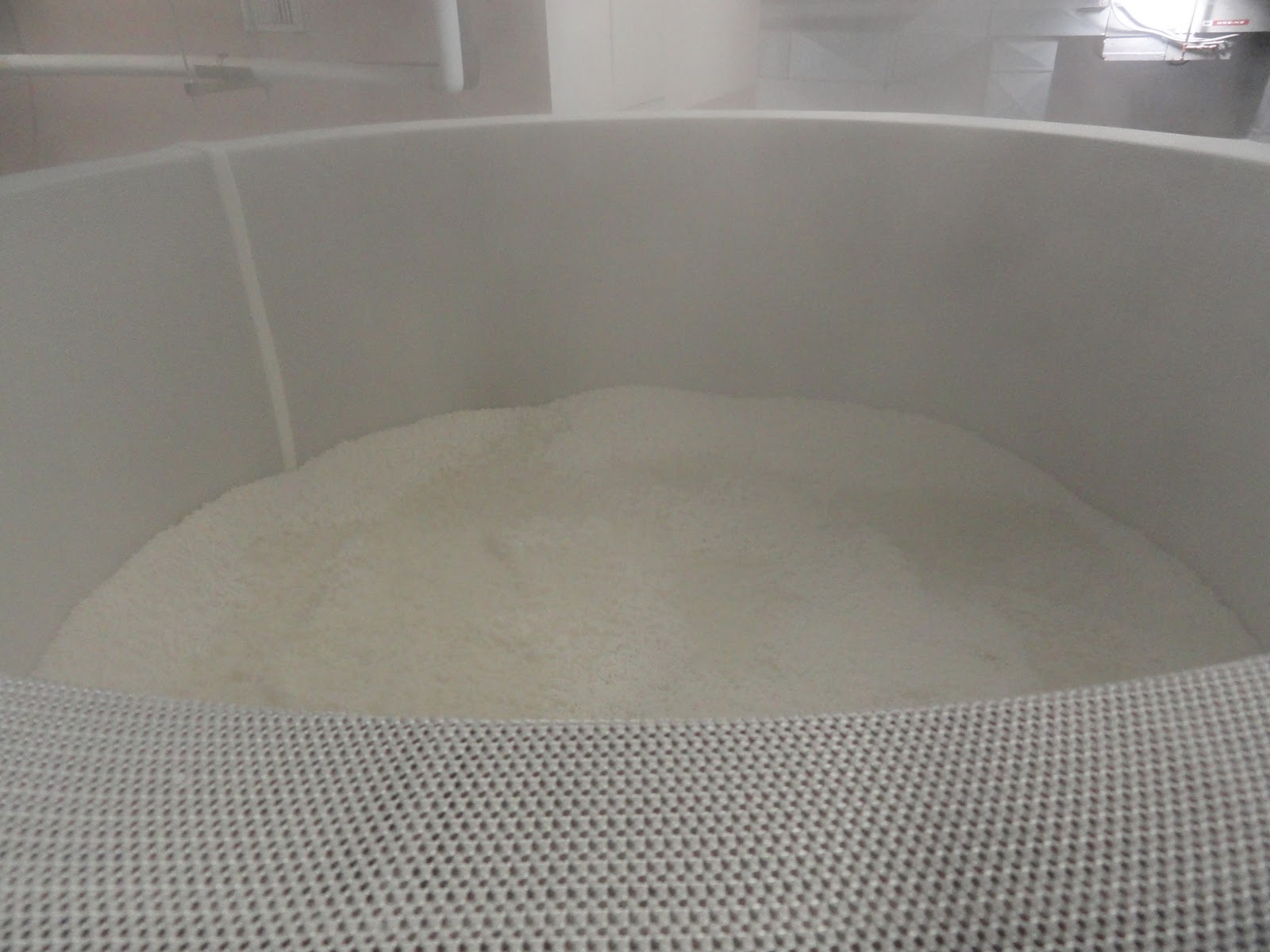
The steaming has begun, which will take about an hour to complete.

This box contains yellow koji-kin, a mold which will break the starch of the rice into sugars so that the yeast can ferment those sugars.

The steamed rice is now fed onto a conveyor belt where the koji-kin will be sprayed upon the rice.

That conveyor belt ends in the koji-muro, the cultivation room, where the koji will begin to transform the starch. The rice will eventually be spread out the length of the table.

SakeOne uses foamless yeast, called awa -nashi kobo, which has some advantages over regular yeasts. As they generate much less foam, a brewer saves time cleaning the foam out of the tanks and can also brew more sake in the tank. With normal yeast, about 1/3 of a tank will get filled with foam but the foamless yeasts will not waste all that space.

The above is a Yabuta press, which resembles an accordion, is used to separate the fermented sake from the lees. Each of the panels is a fine mesh, which prevents the lees from getting through. To make nigori, the mesh panels usually have larger holes, allowing some of the lees to pass through.

Fermentation tanks and holding tanks.

Now, onto the tasting room, which is located across the parking lot from the brewery building.

The tasting room and gift shop has a long counter where you can sidle up and try numerous sakes, including a couple that are on tap. If not tasting, you can peruse the store shelves, viewing what is for sale, from t-shirts to  sake books.

They sell several t-shirts and I love, and own, one of the "Drink Sake Not Bombs" shirts. Down with Sake Bombs!

They also sell some ochoko and tokkuri, sake cups and flasks, as well as a few sake books and other accessories.

The Momokawa brand has seen a recent aesthetic change as the labels have been redesigned. The new labels, pictured above, do seem a bit brighter and more modern, almost an abstract piece of art. The labels are also intended to be more consumer friendly, more descriptive instead of possessing technical terms like the Sake Meter Value. One of their primary goals is to introduce more consumers to Sake, as well as to cater to the American palate. SakeOne produces about 75,000 cases each year, and bottles are generally sold as 750ml or smaller bottles of 300ml or 375ml.

Many of their sakes, for a 750ml bottle, only cost $12 or $13, making them very affordable, and usually less expensive than imported Japanese sakes. One of the reason Japanese sakes are often more expensive is that there is an increased cost for imports, an extra cost that domestic sake does not incur. In addition, SakeOne's cost for rice is probably less than it is for Japanese breweries using sakamai, especially types like Yamada Nishiki. Rice is often one of the most expensive costs in producing sake. The low cost of the Momokawa line makes it a good choice for someone new to sake or for a party if you need plenty of inexpensive bottles.

We need to remember that SakeOne has only been making sake for 13 years, but that they continue to learn and improve all the time. The Momokawa I drank ten years ago is definitely not the same as the Momokawas I tasted at the brewery. The quality has improved during this time as the expertise of their sake brew master has increased, their equipment has been refined and other lessons have been learned. And each year that passes, the quality will continue to improve.

It was actually fun to taste through their current portfolio, to reacquaint myself with their sakes and to assess how they have changed over the years. Overall, I was pleased with their sakes and believe they offer a good value for the price. They offer an excellent way to introduce new people to sake, especially with their infused sakes. Based on my experience to this point, I feel SakeOne is producing the best domestic sakes in the U.S., though I have not yet tasted the sakes of Moto-i or the Texas Sake Company. But, Moto-i is only about three years old and the Texas Sake Co. just opened last month. SakeOne has much more experience than either of these breweries.

The Momokawa Silver ($12) is noted as a "Dry Crisp Sake" and has dry, clean flavors with tastes of melon and green apple. It is simple and pleasant, a nice introductory sake. The Momokawa Diamond ($12) is noted as a "Medium Dry Sake" and has a very nice aroma of floral notes and tropical fruit. On the palate, it offers some tropical fruit and citrus flavors, and seems a softer, though still dry, sake than the Silver.  The Momokawa Organic Junmai Ginjo ($13), noted as "Medium Rich," possesses even more tropical fruit flavors as well as underlying spice notes. It is crisp and dry, and very satisfying on the palate. The Momokawa Ruby ($12), noted as "Lightly Sweet," does seem to have a light sweetness to the taste, with more red fruit flavors as well as touches of melon and pear.  It is rounder and more rich in the mouth. I have previously reviewed their G Joy sake so there is no need to repeat that here.

For the price, you won't go wrong with any of these very approachable sakes.

I tasted a Special Edition sake called "Cloudless Sky,"which was a Nigori, having sat on the lees for four months, but the lees were then removed. So it went from being a "cloudy" sake to a "cloudless" one. This is the first time I have ever tasted such a sake and it was interesting, with tastes of canteloupe and melon, but with a more herbal finish. The Momokawa Pearl ($12) is a more traditional Nigori, sweet, thick and creamy with a prominent coconut taste. The Momokawa Organic Nigori is a thinner, less sweet sake with more restrained tropical fruit flavors. It has been very popular at the sake tastings I have held.

They have a tap where they can offer two draft sakes. The Nama Organic Junmai was maybe only a week old, and had an enticing nose of fresh fruit, and on the palate was crisp and lively. Plenty of delicious apple, pear and hints of tropical fruit. I was very impressed.  I also tasted some Plum Infused Sake, with added carbonation, from the tap, which was only mildly sweet and was rather refreshing. Would be a fun summer drink, or to add to a cocktail.

I tasted through their fruit infused sakes, the Moonstone line, which are intended to introduce newcomers to sake, to be a gateway to other sake. I would agree these are very consumer friendly products, and would also be great used in cocktails. These flavors include Asian Pear, Raspberry, Plum and Coconut Lemongrass. The Momokawa Silver is the base for these sakes, and they are generally sweet, though not overly so. My favorite was the Coconut Lemongrass, and I would love to try it in some Pina Colada style cocktails.

If you are in the Portland area, you definitely should visit the SakeOne kura, sake brewery. Their sakes are available all over the U.S. and it is well worth checking them out, especially at their price point. If you tasted their sakes years ago, but have not tried them recently, then give them another try. Consider using their infused sakes in cocktails, or give them to someone who claims not to enjoy sake and see what they think.

Kanpai to SakeOne!
Read More
Posted in brewery, japanese, Oregon, Sake, Sake Reviews, winery | No comments
Older Posts Home
Subscribe to: Posts (Atom)

Popular Posts

  • Taste Camp: The Wine Industry of Quebec (Part 1)
    Exploring emerging wine regions is always a fascinating endeavor even if their wines are not readily available outside of that region. It is...
  • Tuscan Market: One Stop Shopping & Cafe
    Many of us would love to be able to easily purchase fresh baked bread, fresh local produce, artisan cheese, meats, seafood, fresh pasta, win...
  • Rant: Beware The Self-Proclaimed Expert
    I am very tired of self-proclaimed wine experts, gurus, ninjas and whatever whose actual knowledge is lacking. This is obviously not a prob...
  • Rant: U.S. Sake vs Japan Sake--Context Is Everything
    Is sake produced in the U.S. as good as sake produced in Japan? Does the question require more specificity? Or is it even a fair question? A...
  • Rant: Where Is The Roast Chicken Love?
    1990 was a pivotal year in the battle of beef versus chicken . It was the first year that Americans ate more chicken than beef, and that has...
  • Boston Wine Expo: Pinotage Rosé to Cape Verde
    Here is a sampling of some of the other wines that I found interesting at the Boston Wine Expo , and I will be posting about even more wines...
  • Rant: Rushing To Judge A New Restaurant
    As soon as a hot, new restaurant opens, there is a rush for food bloggers and online reviewers to dine there and immediately report back. Ti...
  • International Boston Seafood Show: Fish Fun & Photos
    “ Fish is held out to be one of the greatest luxuries of the table and not only necessary, but even indispensable at all dinners where there...
  • Rant: Outraged By Sake Prices At Restaurants
    We often hear complaints about the outrageous prices  of wine sold at many restaurants. Some places charge three, four or even fives times t...
  • Rant: Post-Labor Day Wine Advice
    With today as Labor Day , it is seen by many people as a signal of the end of summer, despite the fact that the official end is not until Se...

Categories

  • 2011 (8)
  • 2012 (9)
  • 2013 (2)
  • alabama (1)
  • alaska (1)
  • alcohol (1)
  • allergy (1)
  • alsace (3)
  • Andover (3)
  • animal (1)
  • anniversary (1)
  • Argentina Wines (10)
  • Arlington (11)
  • armenia (1)
  • art (4)
  • Australia Wines (2)
  • austria wines (5)
  • author (12)
  • award (2)
  • Bacon (1)
  • Bakery (15)
  • bar (1)
  • bbq (3)
  • beauty (1)
  • Bedford (2)
  • beer (19)
  • biodynamic wine (1)
  • biography (1)
  • blogging (35)
  • Book reviews (30)
  • book store (3)
  • Boston (165)
  • bourbon (11)
  • braintree (2)
  • brazil wines (1)
  • brazilian (1)
  • breakfast (2)
  • brewery (6)
  • brighton (1)
  • Brookline (9)
  • brunch (15)
  • Burlington (3)
  • business (1)
  • butcher (4)
  • California Wines (20)
  • Cambridge (29)
  • canada (8)
  • Canada Wines (7)
  • candy (3)
  • cape cod (6)
  • cape verde wines (1)
  • casino (7)
  • caviar (1)
  • celebrity (2)
  • champagne (11)
  • Charity (33)
  • cheese (23)
  • chef (27)
  • chianti classico (10)
  • children (2)
  • Chile (2)
  • Chile Wines (2)
  • china (6)
  • chinatown (3)
  • chinese cuisine (8)
  • chocolate (1)
  • christmas (3)
  • cider (8)
  • cocktails (47)
  • colorado (2)
  • concord (10)
  • conference (9)
  • Connecticut (12)
  • consumers (2)
  • contest (8)
  • controversy (97)
  • cookbooks (5)
  • cooking (15)
  • cuba (1)
  • cyprus wines (1)
  • dance (1)
  • Danvers (2)
  • dessert wine (1)
  • desserts (21)
  • diet (2)
  • dining service (1)
  • discount (1)
  • distillery (14)
  • dlw13 (1)
  • donuts (1)
  • dorchester (16)
  • easter (6)
  • Eating Habits (2)
  • ebook (6)
  • ethics (3)
  • ethiopia (1)
  • farming (10)
  • father's day (1)
  • fiction (11)
  • finger lakes (2)
  • florida (1)
  • Food (4)
  • Food Event (8)
  • Food Market (12)
  • food news (2)
  • food processing (2)
  • food safety (4)
  • food truck (1)
  • France (3)
  • France Wines (19)
  • fruit (7)
  • Games (2)
  • gardening (1)
  • georgia wines (1)
  • gin (1)
  • glasses (1)
  • grapes (4)
  • Greece Wines (1)
  • guest post (1)
  • health (21)
  • history (34)
  • holiday (46)
  • hotel (2)
  • Hungary Wines (3)
  • hybrid (2)
  • ibss12 (14)
  • ibss13 (13)
  • Ice Cream (5)
  • ice wine (2)
  • iceland (1)
  • interview (5)
  • ipswich (4)
  • ireland (2)
  • italian cuisine (43)
  • Italy (19)
  • Italy Wines (38)
  • jamaica plain (1)
  • japanese (70)
  • kentucky (12)
  • korea (1)
  • law (13)
  • legend (9)
  • lincoln (6)
  • liqueur (1)
  • local wine (2)
  • los angeles (1)
  • louisiana (2)
  • louisville (7)
  • lynnfield (1)
  • madeira (1)
  • magazine (16)
  • Maine (2)
  • Malbec (1)
  • Malden (1)
  • mallorca (1)
  • mardi gras (2)
  • Massachusetts (4)
  • Massachusetts Wines (6)
  • mead (5)
  • meat (23)
  • Medford (6)
  • melrose (3)
  • mexican cuisine (16)
  • mexico wine (3)
  • mezcal (1)
  • milk (2)
  • milton (1)
  • mississippi (1)
  • montreal (2)
  • mothers day (1)
  • music (4)
  • natick (1)
  • needham (3)
  • new england (2)
  • New Hampshire (17)
  • new year's eve (10)
  • New York (3)
  • New York City (3)
  • New York wines (1)
  • New Zealand Wines (1)
  • newburyport (1)
  • newport (1)
  • news (1)
  • newspaper (7)
  • newton (9)
  • North Andover (16)
  • north end (12)
  • nova scotia (5)
  • Oregon (2)
  • Oregon Wines (6)
  • organic food (1)
  • organic wine (2)
  • paso robles (3)
  • peruvian cuisine (1)
  • phillipines (2)
  • pinotage (2)
  • pisco (1)
  • Pizza (2)
  • pork (3)
  • port (13)
  • portland (1)
  • portsmouth (6)
  • Portugal (6)
  • Portugal Wines (19)
  • poultry (1)
  • providence (1)
  • provincetown (5)
  • quebec (5)
  • rant (97)
  • Reading (1)
  • Recipe (11)
  • Restaurant (198)
  • restaurant going (8)
  • restaurant reviews (65)
  • Rhode island (4)
  • rose (7)
  • rum (11)
  • Sake (61)
  • Sake Reviews (15)
  • salem (2)
  • salmon (4)
  • sandwich (5)
  • science (10)
  • scotland (4)
  • seafood (72)
  • Seattle (1)
  • sherry (10)
  • shochu (1)
  • shopping (3)
  • social media (1)
  • soda (2)
  • Somerville (13)
  • South Africa Wines (7)
  • spain (8)
  • Spain Wines (18)
  • sparkling wines (6)
  • spirits (42)
  • sports (4)
  • st. patrick's day (4)
  • steakhouse (12)
  • sudbury (1)
  • sushi (5)
  • sustainability (61)
  • sweden (1)
  • tastecamp (5)
  • tea (6)
  • television (4)
  • tequila (2)
  • texas (1)
  • thai (2)
  • thanksgiving (9)
  • theater (2)
  • top ten (14)
  • toronto (1)
  • travel (8)
  • twitter (1)
  • united states (1)
  • Uruguay Wines (1)
  • valentine's day (5)
  • vegetables (3)
  • vermont (4)
  • virginia (1)
  • virginia wines (1)
  • vodka (8)
  • Wakefield (1)
  • walpole (2)
  • watertown (1)
  • wayland (1)
  • wbc (3)
  • west concord (1)
  • westwood (1)
  • whiskey (19)
  • Winchester (14)
  • Wine (3)
  • Wine Education (19)
  • wine event (14)
  • wine importers (1)
  • wine marketing (11)
  • Wine news (3)
  • wine pairings (15)
  • wine personality (1)
  • Wine Prices (5)
  • Wine Reviews (68)
  • wine sales (13)
  • Wine Stores (23)
  • Wine tasting (11)
  • wine writing (1)
  • winemaker (4)
  • winemaking (6)
  • wineries (5)
  • winery (21)
  • Woburn (3)
  • women (3)

Blog Archive

  • ▼  2013 (171)
    • ▼  September (5)
      • Why Are You Fat?
      • Thursday Sips & Nibbles
      • Heirloom Flavor: From a Dragon's Tongue to a Nebra...
      • Papa's Pilar Rum: What Would Hemingway Do?
      • Rant: Post-Labor Day Wine Advice
    • ►  August (19)
    • ►  July (18)
    • ►  June (19)
    • ►  May (19)
    • ►  April (20)
    • ►  March (32)
    • ►  February (20)
    • ►  January (19)
  • ►  2012 (283)
    • ►  December (21)
    • ►  November (23)
    • ►  October (30)
    • ►  September (17)
    • ►  August (26)
    • ►  July (23)
    • ►  June (19)
    • ►  May (21)
    • ►  April (20)
    • ►  March (34)
    • ►  February (26)
    • ►  January (23)
  • ►  2011 (46)
    • ►  December (27)
    • ►  November (19)
Powered by Blogger.

About Me

Unknown
View my complete profile