ShrimpTempura

  • Subscribe to our RSS feed.
  • Twitter
  • StumbleUpon
  • Reddit
  • Facebook
  • Digg
Showing posts with label distillery. Show all posts

Wednesday, 27 March 2013

Savoring Michter's Original Sour Mash Whiskey:

Posted on 00:00 by Unknown
George Washington, our first President, was a lover of whiskey. His passion for whiskey was so great that by 1798, he became the country's largest distiller, making 11,000 gallons of whiskey at Mount Vernon. During the Revolutionary War, in the frigid winter at Valley Forge, Washington bought Michter's rye whiskey for his men. Michter's would later say they were “the whiskey that warmed the American Revolution.”

The history of Michter’s extends back to the mid-eighteenth century, when John Shenk, a Swiss Mennonite farmer, settled in Pennsylvania. In 1753, he constructed a small distillery to produce rye whiskey and it soon became very popular, including with Washington. Prohibition forced Michter’s to close though it would reopen once repeal arrived. Unfortunately, Michter's faced bankruptcy in 1989 and that could have been the end of its history as its stills and whiskey stocks were sold.

However, in the 1990s, Joseph J. Magliocco and Richard Newman sought to bring back Michter's, to raise it again to his previous glories. One of their major changes was to relocate from Pennsylvania to Kentucky, and they had a new distillery constructed. They eventually brought on Master Distiller Willie Pratt, who has over forty years of distilling experience, to produce Michter's whiskey. The distillery now concentrates on single-barrel rye, single-barrel bourbon, very small batch bourbon, and unblended American whiskey.

During the 1970’s and 1980’s, Michter's most popular product was their Original Sour Mash Whiskey. When bankruptcy struck, production was stopped though it has only recently, in December 2012, been resurrected.  In a process some liken to making sourdough bread, sour mash whiskey uses a portion of previously fermented mash as a starter for a new mash. Commonly, the previously fermented mash constitutes 10-20% of the new mash. This is done to make the fermentation process quicker as well as create a rounder and smoother whiskey. And it does not give it a sour taste in the least.

Michter’s Original Sour Mash also uses a proprietary mashbill made from a special selection of grains. It is aged in charred, new American white oak barrels and produced in small batches. It is bottled at 86 proof and seems priced at $45-$55. I have never previously tasted any of the Michter's products, though have heard very positive reviews from my friend and whiskey writer, Fred Minnick. I received a media sample of their Sour Mash and brought it with me to my local poker game, to share it with several other whiskey lovers. How would it fare?

It fared quite well, with a number of people refilling their glasses on multiple occasions. Though several other whiskeys were available to them, they chose to keep drinking the Michter's Original Sour Mash. I too was impressed with this Sour Mash. Up front, there was an interesting and complex melange of flavors, including vanilla, orange peel, caramel and chocolate notes (reminiscent of a less sweet bourbon) while the finish came with more subtle spice notes, bringing to mind a pleasant rye. Smooth and easy drinking, there was no bite on the finish. I drank it neat though others drank it with ice.

This is a whiskey I would keep in my home bar, and which would impress my whiskey loving guests. It also motivates me to seek out more of Michter's products, from their bourbons to their ryes. I give the Michter's Original Sour Mash whiskey a strong recommendation.
Read More
Posted in cocktails, distillery, kentucky, spirits, whiskey | No comments

Tuesday, 16 October 2012

Boston Cocktail Summit: Resurrection Of An Icon-Rum On The Rise

Posted on 01:00 by Unknown
"Alcohol is all about escapism."
--Karen Hoskin 

For many people, Rum brings to mind tropical drinks in the Caribbean. Yet Rum involves much more than just the Caribbean and New England was also once a hot spot for rum production. In a previous post, Rum: A Brief History & Trivia, I discussed some of the history of this intriguing spirit. Yet the origins of rum may extend much further back in time, at least according to Karen Hoskin of Montanya Rum.

Karen led a free seminar, Resurrection Of An Icon--Rum On The Rise, discussing its history, the various styles, ingredients, production, cocktails and more. In addition, she discussed a bit about her own rum distillery and rum bars in Colorado. You can read my previous review of her two rums, the Oro Dark Rum and Platino Light Rum. Karen provided some very intriguing information about the history of rum and it was a worthy seminar.

It all began with India. On a beach in Goa, India, Karen began her relationship with rum, sipping some Old Monk Rum and having an epiphany of sorts. As the importer is located in Massachusetts, Old Monk is available locally. In the conventional history, sugarcane allegedly originated in New Guinea around 6000 BC and spread from there to the rest of the world, though Karen believes that sugercane may have also developed independently in India, and that it was an East India strain that led to its hybridization.

In addition, Karen feels, and she is supported by other historians, that India may have produced the first sugarcane based alcohol, the ancestor to modern rum. The ancient Malay people also produced a sugarcane based alcohol that they called "Brum." Interesting how that name is so similar to "rum." During the travels of Marco Polo, he spoke of a sugarcane based alcohol he encountered in Iran. Our more modern rum industry spread from Brazil in the 1620s, to the Caribbean in the 1650s and then New England in the 1660s.

There are two primary rum production ntraditions, that of the islands and that of the mountains, sea level versus higher elevations. Rum also varies by the main ingredient, such as molasses, processed sugarcane juice, or raw cane. Island rums are often molasses based, and it needs to be noted that molasses has a high sulfur content, which can be dulled with age. Island rum also ages quickly and can emit a bit of sulfur on the finish. The quality of the water used to produce rum is also very important.

When producing Montanya Rum, Karen decided to produce a rum in the mountain tradition and using raw cane. Raw cane lacks any sulfurous by products and Ron Zacapa is one of the other rum distilleries that produces a raw cane rum. Montanya Rum uses sugarcane from Maui, Hawaii, which is traceable from a labor union sugarcane farm. Sustainability has become a growing concern for Karen. A $4000 pallet of raw cane will create a couple thousand bottles of rum, a higher yield than they once produced. Colorado water, from a 350 feet deep well, is used, which has a good minerality and would work well to produce any type of spirit.

The distillery is more of an old style facility, using two alembic copper pots from Portugal. They produce about 90,000 bottles of rum annually, split equally between Oro and Platino. Most of their rum is sold in Colorado but it is currently available in 37 states, with major growth in Southern California. The new markets of Atlanta and Las Vegas are also showing potential.

Karen also briefly categorized the history of rum cocktails into four main types: Islands (with tropical fruits), Tiki (with different herbs), Classic (Cuba playing a major role) and Contemporary (with a culinary edge). Karen and Brice Hoskins own 2 rum bars and the only rum sold at those bars are their own two rums. They have over 100 cocktail recipes, and all of those recipes can be found on their website. Their best selling rum cocktail, outselling all others by 2 to 1, is the Maharaja, which is made from fresh ginger, chai spices, and the Oro Dark Rum. We got to try this cocktail and it did have a pleasant spicy edge to it.

Tonight, why not make a rum cocktail and escape.
Read More
Posted in cocktails, colorado, conference, distillery, rum, spirits | No comments

Boston Cocktail Summit: Jameson Black Barrel

Posted on 00:00 by Unknown
In the U.S., Irish Whiskey had great growth from 2010 to 2011, a boost of 23.9%, though it is still a small category at approximately 1.76 million cases. The most popular choice in the U.S. as well as its native Ireland, is Jameson Irish Whiskey. It is ubiquitous in airport duty free shops and Russia has become the second top consumer, jumping from seventh place in the span of a single year. Jameson has just invested in a new distillery to double their capacity and they already possess the largest distillers in the world, which were hand crafted.

Jameson Irish Whiskey held a seminar where they introduced the Jameson Black Barrel, as well as discussed the art of cooperage. I find the art of cooperage in the wine and spirits industry, the creation and maintenance of barrels, to be fascinating. There is still much mystery in the use of barrels, such as how two seemingly identical barrels, containing the same alcohol under the same conditions, can produce different tasting alcohols. It is also an art which retains its historical roots, with some of tools and methods remaining relatively unchanged for thousands of years.  

Master Cooper Ger Buckley, pictured above, is one of four coopers at Jameson. He is the fifth generation of cooper in his family and has been working as a cooper for about 36 years. He has hopes that a nephew will become the sixth generation, though Ger will be getting an apprentice next February. Ger discussed the job of the cooper, showing some of the tools he uses as well as discussing Jameson Irish Whiskey in particular.

The first evidence of cooperage extends back to the ancient Egyptians, around 2000 BC. Many of the tools coopers still use extend that far back as well, including the ax, adze and hammer. All of the tools and activities used in cooperage seems to possess their own unique name. Ger told us that the procedure for cutting trees for staves for barrels is called quarter sawing, as the tree trunk is essentially cut into quarters. Interestingly, when using a plane on a stave, you actually hold the plane solid and move the stave over it, which is the reverse of usual woodwork.

He also explained the reason why whiskey barrels are now charred. Originally, many of the barrels were previously used, such as to store and transport fish. That fish smell pervaded the barrel so would have ruined the taste of the whiskey. Just cleaning the barrel was insufficient to remove the fish smell so they charred the inside of the barrel to remove the odor. They later realized that the whiskey actually tasted better in the charred barrels, and started to do so even when it wasn't necessary.

Did you know that the first Kennedy brothers to come to Massachusetts were coopers?

This is a short video of Ger taking apart a barrel so we could have a closer look at an individual stave. It is interesting how everything fits together as it does, sufficiently tight so that no liquid leaks out.

For Jameson, they use only high quality barrels, obtaining their used bourbon casks from a U.S. distributor and their used sherry barrels from a bodega in Jerez. Their whiskey does not possess an age statement as the blender does not want to be restricted, desirous of the ability to select whiskey when he feels it is ready. In general though, the regular Jameson Irish Whiskey has a rough age of 5-7 years while the Black Barrel has a rough age of 8-16 years.

At distilleries, you may find pot stills or column stills, or even both. But, in the world of Irish Whiskey, "pot still whiskey" has a specific meaning, and not what you might think. It is a blend of malted and unmalted barley produced in a pot still. It is the unmalted aspect which differs from usual pot distilling. It was originally created in an effort to reduce an English tax on malted liquor. In general, it leads to a creamier mouthfeel in the whiskey.

The Jameson Black Barrel ($35-$40) is only made once a year, a total of around 9000 cases, and is sold in only a limited amount of countries. They wanted to create a sweeter style whiskey and I believe they succeeded in their objective. The Black Barrel is a blend of pot still whiskey and small batch grain whiskey, and they use virgin bourbon casks for aging. It has a sweet aroma, actually reminding me a bit of a nice bourbon, and on the palate, there is plenty of sweetness, yet not cloying. There were creamy tastes of vanilla, caramel, honey and even toasted marshmallow. It was mellow and smooth, with a lengthy and pleasing finish. A fine sipping whiskey, especially on a chilly autumn or winter evening.
Read More
Posted in conference, distillery, ireland, spirits, whiskey | No comments

Friday, 12 October 2012

Boston Cocktail Summit: Spirit Recommendations

Posted on 01:00 by Unknown
You can't have a conference dedicated to spirits and cocktails unless you provide plenty to taste and drink. At the Boston Cocktail Summit, they certainly provided ample opportunity for tasting and drinking, from some of the seminars to the evening parties. In addition, there was a Craft & Fine Spirits Showcase, separated into a Grand Tasting Room and a Craft Distiller's Hall, where a myriad of spirits and cocktails were presented for sampling.

I spent several hours on Saturday sampling in these two rooms, generally passing on those spirits I already knew, seeking out the different, interesting, unique and unusual. Tasting so many spirits is not an easy task, as even if you spit, you still absorb some of the alcohol. It is more difficult than wine tasting due to the much higher alcohol content of the spirits. Fortunately, both rooms had some snacks to help cleanse your palate and absorb some of the alcohol. Plus, taking a lunch break, a burger and tater tots, helped keep me going for  more tasting in the afternoon.

This is a great time in the spirits world, and there has never been a greater number and diversity of artisan and high-end spirits available. No matter what your preference, you can find plenty to please your palate. And if you are adventurous, you will find much to satisfy you, much to delight and tantalize you. I am going to highlight some of the alcohols which most impressed and excited me, those which intrigued me because of their uniqueness and fine taste. I may follow up on some of these spirits in the future, to gain more information about their creation, and if so, I will report back.


Let me start with some local spirits. I previously toured Turkey Shore Distilleries, sampling three of their rums. At the Summit, they presented their newest offering, which had only been bottled less than a week before. The Old Ipswich Golden Marsh Spiced Rum, a limited edition, is basically a blend of 80% of their White Cap rum and 20% of their Tavern Style Amber with the addition of ten different spices. Master Distiller Evan Parker says, "With the cooler weather, we created a flavor profile that is perfect for those crisp days out and about or for those cold nights by the fire."

The rum presents a bright, golden yellow color and a spicy aroma, which will bring to mind autumn and cool weather. It has a smooth taste, with delicious fall spice notes and hints of orange peel. This is definitely a rum to enjoy now, either on its own or in a cocktail. Evan states, "For a simple, tasty cocktail, you can pair Golden Marsh Spiced Rum with ginger beer or hot cider." I could easily see this rum added to some hot cider.

They also had an intriguing cocktail to taste, which was made from the Golden Marsh Spiced rum, caramel, butterscotch liqueur, and spiced apple cider, topped with a Pumpkin Munchkin. The rum complemented this drink very much and I think apple cider is a great pairing. The guys from Turkey Shore, Mat Perry and Evan Parker have created another winner.

Grand Ten Distilling is another local distillery, located in South Boston, and Luke O'Neil has just written an interesting article in The Phoenix about this distillery. For background on the distillery, you should check out his article though it only discusses their Wire Works Gin (which I did not taste). I tasted three of their other products and found all three to be interesting.

The Amandine Barrel Aged Almond Liqueur spends about 6 months in 30 gallon American oak barrels. They use 30 gallon barrels as it is easier for two people to move them around rather than the usual 53 gallon barrels. The barrels are toasted, not charred, as they do not want the barrels to filter out any of the taste. All the color of liqueur is due to the barrels. The liqueur had a pleasant almond taste, not too sweet, and would make a fine addition to a cocktail. The Angelica Botanical Liqueur is made with angelica root, cinnamon, orange peel and cloves. It too is not sweet, but is aromatic and floral with a fresh, clean taste and slight hints of spice. Another liqueur that would add interesting flavors and aromas to a cocktail. The Fire Puncher Fire Vodka has a hickory smoked and pepper flavor, and I found the peppery notes to be far more prominent than the mild smokiness. It is farily easy drinking and would be great in a Bloody Mary.

Another local company, in Somerville, is Infusion Diabolique which is a collaboration between Executive Chef Robert Fathman and Brandon Bach, both who worked at Azure. They produce infused alcohols and at the Summit showcased two of them, their bourbon and tequila, though it appears they also make an infused rum. They are all infused with natural fruits, herbs and spices.

The Infusion Diabolioque Kentucky uses a four year old bourbon and infuses it with dried organic Black Mission figs, Madagascar & Tahitian vanilla, cinnamon, star anise, black currants, cloves, and allspice. It smells like typical bourbon with subtle spicy notes and on the palate, the bourbon flavor is enhanced by subtle fruit flavors with a pleasant melange of spices. It was smooth and easy drinking, and would satisfy you on its own, though it would do well in a cocktail too. The Infusion Diabolioque Mixto is a silver tequila infused with sweet pineapple, Persian limes, cardamon, and mint. Up front, the usual tequila flavors are most prominent, but it then transforms into a more complex blend with some tropical fruit accents and subtle mint. The finish is smooth and long, with hints of lime. Again, it would work well on its own or in a cocktail.

Dunc's Mill is the oldest continuously operating distillery in Vermont. The founder, Duncan Holaday, previously created Vermont Spirits but now has moved on to creating local rum. He currently produces two rums, both which are made from Fair Trade, organic sugar cane and Vermont flavors. The Elderflower Flavored Rum is created with Vermont elderflower blossoms and Austrian elder essence, which is infused into a light rum. I was impressed with this rum, which possessed a delightful floral aroma, and on the palate was smooth, clean and dry with a prominent, but not overwhelming, taste of elderflower. It was a well balanced spirit which reminded me somewhat of a dry version of St. Germain Elderflower Liqueur. I am not a huge fan of maple flavor but their Maple Flavored Rum, made from Vermont maple syrup, was pleasant. It was dry and possessed a milder maple profile, once again also smooth and clean. Another well balanced spirit, you should check out both these rums.

In 2006, the Consejo Regulador Del Tequila (CRT), the ruling tequila body in Mexico, added a couple new tequila categories: Extra Anejo and Infused Blanco Tequila. Tanteo has taken advantage ot the later of the two categories and currently produces three Infused 100% De Agave Tequilas ($36-$40). Their inspiration was the fruit cups, topped with chiles, they found in Mexico. Their blanco tequilas, Jalapeno, Cocoa and Tropical, are infused with natural ingredients, such as organic jalapenos.

Their Jalapeno was my favorite of the three, and it is produced by infusing organic jalapenos, hand-sliced, which are mixed in a 10,000 gallon tank with the tequila. On the nose, there is some grassy notes as well as the typical agave, and on the palate, the tequila flavor was very prominent up front. On the finish, rather than the usual tequila bite, you ended up with a spicy and delicious jalapeno burn. It was not overly spicy, but very noticeable and I loved that heat. I could easily enjoy this on its own though it would make great cocktails as well.

The Cocoa is made with roasted, malted and raw cocoa, like a traditional mole, and has a little jalapeno added as well. It presented a strong cocoa flavor atop the tequila notes, a strange combo that actually worked, and certainly was intriguing, though not my personal preference for a spirit. Yet I could see it working well in the right cocktail. The only issue is that I didn't get much of a jalapeno kick to this tequila. The Tropical is infused with pineapple, mango, and guanabana, also known as soursop, and there was a little jalapeno added too. The tropical fruits added subtle flavors, enhancing the tequila, though again the jalapeno wasn't really assertive. I could see this tequila working well in a tropical cocktail.

The Macchu Pisco La Diablada is intended to be a high-end Peruvian Pisco and is currently not available in the U.S. but that will hopefully change soon. They only make 1000 bottles so even when it becomes available, it will be in very limited supply. La Diablada is a blend of 3 Pisco grapes: Quebranta, Moscatel and Italia. It is rested, not aged, for about 18 months and sees no oak. It is very aromatic with a smooth taste of herbs and fruit, with some underlying spiciness. A complex taste with a lengthy and pleasing finish. Though many know of the Pisco Sour, this is a Pisco that you might want to enjoy on its own, rather than as the base for a cocktail.

I love a good bourbon and the Rock Hill Farms Bourbon, produced at Buffalo Trace, really excited my palate. It is a single barrel, Kentucky Straight bourbon that is 100 proof, though you probably won't notice the alcohol is that high. It is an excellent sipping bourbon, smooth, complex and absolutely delicious with nice vanilla notes and intriguing spicy elements on the finish. This is definitely a bourbon I will add to my home bar.

Brendan Edwards of Third Wave Brands, a supplier of spirits and wines, presented several different brands (including Montanya Distillers, Delirio de Oaxaca, and Cariel Vodka) and I found them compelling.

Montanya Distillers, owned by Karen & Brice Hoskin, was founded in 2008 and is now located in Crested Butte, Colorado. which is is the West Elk Mountain range of southwest Colorado. They currently produce two rums, the Platino Light Rum and Oro Dark Rum. The rums are all natural, each made with only four ingredients, including water, sugar cane, yeast and honey. The water comes from Colorado mountain springs while the sugar cane is from Maui, Hawaii. At the time of bottling, a tiny bit of Colorado mountain honey is added to the rum.

The Oro is aged in a fresh, American oak whiskey barrel that previously held Stranahan's Colorado Whiskey. The Oro was a fine sipping rum, with a pleasant blend of flavors, including vanilla, honey, caramel, and mocha hints. I really enjoyed it and would drink it both straight or in a cocktail. The Platino is aged in a barrel that once aged Oro, so the barrel has far less effect on the rum. The Platino is also filtered and I found it to be very aromatic, a lighter rum with vanilla and herbal notes. For me, it would be best used in a cocktail.

Delirio de Oaxaca is a traditional palenque in Matatlan, Oaxaca, producing Mezcal by Master Distiller Fernando Santibanez. The Mezcal Joven is double distilled in copper alembics from 100% Agave Espadin and only 10,000 bottles were produced. It had an intriguing smoky nose with a prominent taste of agave fruit and a mild smokiness. Quite tasty and I could drink it on its own or in a cocktail. The Mezcal Reposado has been aged for about 4 months in lightly toasted American oak and only 5000 bottles were produced. It had a lighter nose of smoke, and on the palate it was softer and more subtle, with the same delicious fruit flavors and hints of smoke. Again, another winner.

Cariel Vodka was created by Master Blender Peter Carlson in Sweden, who desired to create a vodka with natural flavor and the product just came on the U.S. market in July. It is produced from Swedish winter wheat and barley, as well as glacial water from Lake Vattern. I found the vodka to have an almost subtle sweetness to the aroma, with an intriguing and smooth taste, elements of herbs, grain, and subtle peach flavors. It is definitely not a tasteless vodka but rather presents an enticing melange of subtle tastes. I was impressed. They also produce a Vanilla Vodka, made with the addition of vanilla from Southern India and Madagascar. It had a big, bold vanilla aroma and flavor, yet it remains only mildly sweet, not cloying like many other flavored vodkas. I can see this working well in the right cocktail.

Koval Distillery, founded in 2008, was the first craft distillery in Chicago since Prohibition. The founders, Robert and Sonat Birnecker, gave up their academic careers to create the distillery. Using custom-made Kothe potsills, they produce organic and kosher liqueurs and whiskey. The whiskey is made in small batches from 100% Midwest organic grain from Midwest and aged in 30 gallon organic oak from a Minnesota cooperage.

My favorite of the three I tasted was the Lion's Pride Dark Rye, made from 100% Rye. It presented nice vanilla and bold spice flavors with hints of citrus. A nice sipping whiskey. The Lion's Pride Dark Millet had a more earthy flavor with vanilla accents. The Lion's Pride 47th Ward is made from a mash bill of rye, wheat, oat and malted barley, and is aged in heavily charred oak. Each grain is distilled separately. This is a complex and spicy whiskey, but at 94 proof, you probably need to add a little water to mute some of the alcoholic heat.


In general, I am not much of a Gin guy because I find too many gins with a strong juniper taste. But, I have found myself enjoying much more the ancestor to gin, Genever, which is made with numerous botanicals and where any juniper flavor is far more subtle. Veronique Beittel is the owner of Flemish Lion, an importing company, based in Vermont, of Belgium Genever. She even has an informative website of information about Genever. At the Summit, she was showcasing two Genevers from Diep9.

The Diep Young Genever is distilled using 19th century techniques, hand crafted in a traditional copper pot at De Moor, Belgium's smallest family owned distillery. It is produced with a combination of rye, wheat, malted barley, and nine botanicals. Those botanicals include juniper berries, sweet orange peel, blessed thistle, carob, nutmeg, guinea pepper, angelica root, cinnamon and coriander. I liked the herbal blend on this spirit, which was relatively smooth and easy drinking. I think the key was the balance of the botanicals, that none of them seemed to overpower the others. The Diep9 Old Genever is distilled using 16th century techniques and is barrel aged for two years in French oak. It is also packaged in an old style clay bottle. Though it too has a balanced, herbal taste there is also a deeper, earthier element, which really intrigued me. Try these Genevers and let them open your eyes to the possibilities.

Palm Bay International is a distributor of wines and spirits and they showcased several of their products at the Summit, from mezcal to whiskey.

Los Amantes, which translates as "the lovers" and is inspired by an ancient Aztec legend, produces Mezcal  made of 100% agave from Oaxaca. Only a small supply of this traditionally produced spirit is available in the U.S. The Joven has about 2 months of barrel aging and the nose had a mild smokiness with a bit of brininess as well. On the palate, it was smokier, with strong fruit flavors and a nice smoothness to the finish. Delicious and easy drinking. The Reposado has been aged for about 6 months in American oak and its taste was superb, a complex melange of flavors, smokiness and subtle accents of fruit. An excellent sipping spirit, it is highly recommended.

The Bastille 1789 is a French blended whisky hand-crafted in the Cognac region and produced from barley and wheat grown in northeast France. Their water derives from the Gensac Spring and it is naturally filtered through limestone. It has been finished in French Limousin oak casks. It was an intriguing whiskey, with a complex blend of flavors, with orange notes, dried fruits, honey and Christmas spices. There was a mild earthy backbone, and it was smooth and easy drinking with a satisfying finish.

The Irishman, founded in 1999 by Bernard and Rosemary Walsh, produce a line of Irish whiskey based products. The Original Clan is a pot still blend of 70% single malt and 30% pure pot still. It was triple distilled and matured in bourbon casks. This was produced in a pre-Prohibition style and is said be be a "gateway" Irish whiskey. This is a delightful sipping whiskey, with delicious flavors of caramel, honey, vanilla and butterscotch as well as slight undertones of pepper and spice. It goes down so easy and lingers in your mouth for a long time. I can understand why so many people will enjoy this whiskey.

The Single Malt is produced from 100% malted barley, was triple distilled and then matured in first-fill bourbon and sherry oak casks. Only 1000 cases of this whiskey were made. This is a more serious whiskey, being complex, subtle and intriguing. There is less sweetness than the Original Clan and a bit more spice, and the finish is even longer and more pleasing. This is definitely a whiskey to slowly sip and savor, and will appeal to whiskey aficionados.

The Superior Irish Cream is a blend of real Irish cream and 100% Irish whiskey, with added hints of vanilla and toffee. All of the ingredients are natural and it does not contain any thickening agents or artificial ingredients. It is based on an old family recipe and was a satisfying pleasure. There is a thick, creaminess to the drink and the whiskey flavors are not hidden in the least. It does not taste artificial in any way, and with winter approaching, you might want to stock up on a couple bottles for those chilly evenings. Add a bit to your coffee or tea, or just drink it on its own.
Read More
Posted in Boston, bourbon, cocktails, colorado, conference, distillery, gin, ipswich, kentucky, liqueur, Massachusetts, mezcal, pisco, rum, Somerville, spirits, tequila, vermont, vodka, whiskey | No comments

Wednesday, 10 October 2012

Boston Cocktail Summit: How The Spirits Industry Works

Posted on 01:00 by Unknown
"In sales, you need a story."
--Sam Rubenstein

That is a truism, something I have also stated on multiple occasions before. Stories can fascinate and intrigue consumers, creating an emotional connection which would be missing otherwise. And if you consult the studies and science, it is that emotional connection which plays a very significant role in consumer behavior. Storytelling has been a part of our history and culture from the very beginnings of time and it still resonates deep within our souls.

At the Boston Cocktail Summit, the first seminar I attended was "How The Spirits Industry Works," which was led by Brandy Rand, a writer and consultant with 12 years in the beverage alcohol industry in marketing and PR, and Sam Rubenstein, one of the owners of Horizon Beverage, a New England distributor of wine, beer and spirits. This was a more educational seminar, full of history, laws and statistics yet Brandy and Sam kept it lively and interesting.

The discussion began with an explanation of the Three Tier system, the manner in which alcohol gets from the supplier/manufacturer to the retailer, via the middlemen of wholesalers/distributors. That topic could have easily been the focus of its own seminar. It was stated that a significant reason for this system is to more easily collect taxes. It is amazing that approximately 55% of the price of a bottle of spirits is a tax of some type. Spirits get taxed more than wine and beer and that can be seen in the federal excise tax. For distilled spirits, the tax is about $14.50 per proof gallon while it is only $6.18 for beer and $4.86 for wine.

It was noted as well that the Three Tier system can limit consumer choice, that some small brands can have difficulty gaining access to the market. In addition, in some states, a supplier/manufacturer must stay with their original distributor and cannot leave even if that distributor does a poor job of selling their products. We didn't get into an involved debate over the advantages and disadvantages of the Three Tier system, but the presenters did acknowledge some of the pluses and minuses.

We moved on to some specific laws dealing with Massachusetts, though also setting a foundation with the standard industry drink sizes. That includes 12 oz. beer, 8 oz, malt, 4.5 oz. wine, 3.5 oz. fortified wine, 2.5 oz. cordial/liqueur, and 1.5 oz. shot of 80 proof spirits. Since 1994 in Massachusetts, you can now get a Cordial & Liqueur license, which allows you to sell some spirits but the determination of which spirits are permissible is based on sugar content and not alcohol content. The Cordial/Liqueur must contain at least 2.5% sugar, and the proof level is irrelevant. That license allows restaurants and bars to create unique cocktails form cordials and liqueurs.
 
With the potential advent of casinos in Massachusetts, the issue of Happy Hours has risen once again. Currently, establishments cannot provide discount pricing for liquor for a Happy Hour, though discount pricing is permitted if it lasts for an entire week. Casinos often provide free cocktails and they will likely seek to provide such in Massachusetts as well. So there have been some calling for Massachusetts Happy Hour laws to change. Yet Sam claimed that the vast majority of Boston restaurants and bars are actually against lifting the Happy Hour restrictions.

For many bars and restaurants, they usually make the greatest margin from alcohol and not food. So, if they have to discount their alcohol, they often will cut deeper into their margin than if they offered a discount on their food. So there is a clear business reason why they might oppose lifting Happy Hour laws. In addition, as Happy Hours tend to make people drink more, that can heighten the potential liability of restaurants and bars for drunk patrons.

Now on to some statistical information, mainly concerning spirits, figures which certainly intrigued me. We begin with the fact that about 110 million Americans legally drink alcohol. Spirits production, sales and consumption have been rising in the U.S. In 2011, the value of spirits increased by 2.7% while spirit exports reached a high of $1.34 billion. Of that export figure, about 69% consisted of American whiskey and the European Union purchased about 47% of that whiskey.

In the U.S. market, the share of spirits has risen 4.2% since 2000. Currently, the market is divided into 52.2% beer, 31.8% spirits and 15% wine. Since 1995, shares of wine and spirits have both increased while shares of beer have actually decreased. In 1995, beer occupied a 61% share, but we can see that has dropped nearly 9%. I think spirits have gained market share because of the boom in more artisan and high end spirits that are now entering the market. Twenty years ago, spirit selections were much more limited but now the selections almost seem endless. The added choice is certainly welcome.

Yet, despite all these added choices, it is difficult for a small brand. Currently, about 25 brands occupy 45% of the spirits volume in the U.S. The top 5 brands are Smirnoff, Bacardi, Captain Morgan, Jack Daniels and Absolut. It takes at least 5 years for a brand to reach big name recognition. Since 2009, there have been about 1800 new spirit products although most of those were merely line extensions, different flavors of a known brand, many which will come and go. It is interested that growth in the "super premium" category has grown +8.9%.

As for individual spirit categories, it is also interesting to see what has been popular, the changes that have occurred from 2010 to 2011. Vodka continues to reign supreme, growing 6%, and selling about 65.8 million cases. Considering other spirits, rum has risen 1.3% (25.8 million), tequila has risen 3.8% (12 million), American whiskey has risen 5% (20.85 million) and Irish whiskey had a huge jump, up 23.9% (1.76 million). Brandy & cognac remained at the same level (10.37 million) though a few other spirits saw a decline. Gin decreased 2% (10.8 million), cordials decreased 1.2% (19.4 million) and even Scotch decreased 1.4% (8.5 million).

Another reason for the increased market share of spirits may also be due to the growth of microdistillers across the country. If we look back in history, to around 1800, we know that there were over 14,000 distilleries in the U.S. Fast forward to 1993, and there were only about 60 microdistillers around, a microdistiller being one which produces less than 40,000 cases annually. Now, there are over 250 microdistillers across the country, with new ones sprouting up all the time.

Overall this seminar was quite fascinating, with plenty of valuable information, and it would have been even better if it had been longer as there was much more they could have discussed. As the first seminar I attended, it set an excellent and positive foundation for the others to come. Fortunately, all of the seminars I attended were worthwhile, both educational and entertaining.
Read More
Posted in business, cocktails, conference, distillery, law, spirits | No comments

Tuesday, 9 October 2012

Boston Cocktail Summit: Overall Impressions

Posted on 01:00 by Unknown
What is your favorite spirit or cocktail?

The city of Boston has a rich and vibrant history of alcohol, distilling, cocktails, bars, restaurants, speakeasies, bartenders, mixologists and much more. The rest of Massachusetts and New England has a similar history as well. So it is only appropriate that there be a festival to celebrate all such matters, to reach back into this fascinating history as well as to blaze a path for the future.

Consider the fact that the spirits category now occupies 31.8% of the US alcohol market, a figure that has been slowly increasing over the years. In comparison, wine occupies only 15%, a figure that is increasing, while beer occupies 53.2%, which has actually been decreasing over the years. Spirits are very popular and cocktails are all the rage.

The first annual Boston Cocktail Summit has now come to a close. For three days, Thursday through Saturday, there was a gathering of bartenders and mixologists, spirit and cocktail lovers, distillers and vendors, authors and readers, and others as well. The Summit was not just for industry people but was open to any and all who had an interest or love of spirits and cocktails. There were a myriad of events, from educational seminars to tasting rooms, from author signings to elaborate parties.

I attended all three days of the festival as a media guest, and overall I was very happy with the festival. As it was their first festival, there were definitely some challenges and logistical problems, but the concept and the content showed great potential and I eagerly await next year's event.

Most of the Summit events were held in two hotels, the Royal Sonesta in Cambridge and the Boston Park Plaza. A few of the other events, especially on Thursday, were held at different locations, such as local bars and restaurants, from Citizen Public House to The Black Rose. You essentially paid only for the events you wished to attend, with the average cost per event being $25-$35 though there were some free events as well. If you wanted to attend all three days, you could also purchase a special 3 day Summit Pass for $325, which garnered you a savings of at least $200.

There was a great diversity of events, from cocktail parties at local bars, like the National Vodka Day Party at Stoddard's Fine Food & Ale, to over 50 seminars & panel discussions on a wide range of spirit and cocktail topics. There were book signings in the Author's Lounge and a pop-up branch of The Boston Shaker cocktail supply store. You could taste a myriad of spirits and cocktails in the various tasting rooms, from local craft distillers to some of the big name brands. There was plenty to do, and much to sample and drink. You certainly had to monitor your alcohol intake or you might end up slurring and staggering the halls. Fortunately, the attendees seemed to be careful and I didn't notice any problems with drunken people wandering the halls.

A number of well known spirits and cocktail experts attended the event, including Tony Abou-Ganim, Wayne Curtis, Dale DeGroff, Paul Pacult, David Wondrich and others. They signed their books, led seminars and hung out with everyone at the various parties. There were also a number of local celebrities who attended, some of the top bartenders, mixologists, writers and others, in the city. You could also meet and chat with numerous distillers, some local, who were presenting their spirits in the tasting rooms. Everyone I met was very personable and down to earth. Just a bunch of cool people who like to drink.

There was an air of fun and festivity throughout the Summit. Kind of hard not to have fun when there is so much alcohol freely flowing. Everyone I met was very friendly and there was a nice sense of community within the halls. Even got to meet a couple people I had previously known only online. The event was not overly crowded so you were able to relax and leisurely talk with the vendors in the various tasting rooms, learning much about their products. I know that some people were concerned about the seeming low attendance level, but it was difficult to fully assess that number of attendees when they were split between two hotels. We also have to realize that this was only the first Summit, and even more people are likely to attend next year. I think it was a great start.

With over 50 seminars available, they covered a wide range of interesting topics and it was tough to decide on which events I wanted to attend. Some of the seminars were geared more toward industry people while others would appeal to any lover of spirits and cocktails. There were seminars teaching you how to make cocktails while others allowed you to taste a variety of spirits. Whiskey, vodka, rum, gin, pisco, mezcal, amari, tequila, absinthe and more were showcased in these seminars. There was plenty of practical information available and I wished I had been able to attend many more of the seminars.

I ended up attending four seminars, with logistics preventing me from being able to easily attend more, but I very much enjoyed all four. The speakers did very well, the content was interesting, and each seminar was both educational and entertaining. The panels I attended included: How The Spirits Industry Works, The Subtle Nuances of Vodka, Jameson Black Barrel and The Resurrection of an Icon: Rum on the Rise. I will be posting more about these seminars in the next couple weeks.

The Bacardi 150th Anniversary Party went with a 1950s Havana theme and they did a great job of imbuing that ambiance into the party. At these parties, the bartenders were preparing numerous cocktails, and it was an open bar so you could taste and try a number of different drinks. The Beam's Bourbon County BBQ was a bit of a let down as many attendees were expecting more of a dinner event but it ended up being only some passed appetizers. The hungry attendees mobbed the servers as they entered the patio and those servers didn't make it ten feet inside before their plates were empty. The event description should have been much more specific on the nature of the event.

In the tasting rooms, I spent plenty of time on Saturday sampling a variety of spirits and cocktails, finding some new ones which greatly appealed to me. A jalapeno infused Tequila, rum from Colorado, smoky Mezcal, an elderflower rum from Vermont, compelling Irish Whiskey, Pisco cocktails and much more. New England distilleries and spirit producers were well represented. This was a great opportunity to check out new products as well as others of which I was unaware. In the next couple weeks, I will be sharing my discoveries with my readers.

Sweet Potato Tots! Obviously, as I spent plenty of time at the Sonesta, that meant I had to stop by the ArtBar, at least a couple times, to snack upon some crisp, lightly sweet and delicious tater tots. I was far from alone and I watched many an order of tater tots exit the kitchen. They make a great cocktail snack, or a side dish with lunch or dinner.

My main complaint with the Summit were the logistics of running the event in two separate hotels. As these hotels were a distance apart, this caused difficulties as you almost had to choose to remain at one hotel or the other for much of the day, or otherwise waste time in traveling and miss certain events. When I signed up for the Summit, I had carefully chosen my events, trying to arrange my schedule around the two hotels so any travel was minimal. Unfortunately, the Summit had to reorganize matters at the last minute, changing the locations of numerous events. That led to my schedule no longer being a good choice so I had to adjust.

For example, I attended a seminar at the Park Plaza and once it ended, my next seminar, which started right away, had been rescheduled for the Royal Sonesta. There was no way I could get to that other hotel in 5 minutes so I couldn't attend that seminar. The organizers though did allow people to attend a different seminar if such a situation arose. Having all of the events at one hotel would easily resolve those issues, and the organizers seem cognizant that it was a problem this year. So I expect next year they will work on that matter.

We need to remember that this was the first time this event has been held, so there were bound to be such logistical issues. What was most important, the concept, content and passion, were clearly evident and the lessons learned this year will create an even better Summit next year. I enjoyed myself very much at the Summit, and it was educational, informative, tasty and fun. Others I spoke to also seemed to enjoy many of the events, and they would be likely to return again next year. Kudos to the organizers of the Boston Cocktail Summit for all their time and effort in bringing this event to a reality. Let us look forward to an even better event next year
Read More
Posted in author, Boston, cocktails, conference, distillery, spirits | No comments

Tuesday, 24 July 2012

Vermont Cheesemakers Festival: The Beverages

Posted on 01:00 by Unknown
Smile and say "Cheese." Vermont cheese. 

This past Sunday, I journeyed to Vermont, just south of Burlington, to attend the 4th Annual Vermont Cheesemakers’ Festival at Shelburne Farms. This was my third time attending this event, and I was invited as a member of the media. Presented by the Vermont Cheese Council, the event showcased over 40 Vermont cheesemakers, presenting more than 200 Vermont cheeses for sampling. If all that cheese doesn't excite you, then maybe you need to check your pulse. Rachel Schaal, of the Vermont Cheese Council presented an interesting statistic, "In fact, Vermont has the highest number of cheesemakers per capita." Sorry Wisconsin.

The festival is held in a beautiful setting, in a Coach Barn located on a huge estate and the barn is situated next to the shore of Lake Champlain. In addition to the multitude of cheeses, there were also a number of specialty food vendors, selling items such as candy, croutons, pickled vegetables, hot sauces, and more. Plus, you could find numerous Vermont wineries, breweries and distilleries providing tastings of their products. The only criticism is that this event gets very crowded, so that you will have to wait in line for many of the samples, especially at the alcohol tables. Fortunately, the press gets into the event an hour earlier than the public, so we have the opportunity to speak with the various vendors in a more relaxed setting.

In this post, I am going to highlight some of the beverages, primarily alcoholic, which most interested me. I did not taste all of the alcohols that were available, though I have tasted many of them on prior visits.

One of my best finds at the event was the WhistlePig Straight Rye Whiskey ($70), a small batch rye. By U.S. law, "rye whiskey" must be produced from a mash that is at least 51% rye, be distilled to no more than 160 proof, and aged in charred, new oak barrels. To be "straight" rye whiskey, it must also be aged for at least two years. Prior to Prohibition, rye whiskey was very popular and even George Washington produced some. But its popularity waned though we have begun to see a surge in popularity in recent years. The key to the taste of rye whiskey is its spicy component.

Whistlepig was founded in 2006 by Raj Peter Bhakta and he hired Master Distiller David Pickerell, who spent 14 years at Maker's Mark, to produce a rye whiskey. Raj purchased an old dairy farm in Shoreham, Vermont, and is currently planting rye, with an eventual goal of becoming the only single estate rye distillery in the U.S. Whistlepig is made from 100% Rye, which currently comes from Canada, and it is now aged and bottled at the farm in Shoreham. The rye is 100 proof and has been aged a minimum of 10 years, seven in new, charred oak barrels and three more in used bourbon barrels. It was initially released in 2010 and only 1000 cases were produced, though 2011 production may have doubled that figure.

The aroma of the Whistlepig is a complex melange of appealing spice notes, all which present themselves up front on the palate, including some clove, anise, nutmeg, as well as hints of vanilla and caramel. It is the lengthy finish though that is even more impressive, silky smooth with a rich and compelling taste of butterscotch, vanilla and mint. This is definitely a fine sipping whiskey, something to slow savor with good friends. It will appeal to both newcomers to rye whiskey as well as those who already enjoy such spicy spirits. Highly recommended!

I love vodka, but I am very picky as I prefer my vodka ice cold, maybe on ice, but with nothing else added. I enjoy some vodka cocktails too, but my preference is the vodka on its own. The Barr Hill Vodka ($57), produced by Caledonia Spirits in Hardwick, Vermont, intrigued me. Caledonia is a distillery and winery founded by Todd Hardie, who has been a beekeeper since 1965. In 2006, he started working with a local wine maker to produce mead, a natural fit considering his beekeeping. Caledonia also produces Gin, Elderberry Cordial and Vodka.

The Barr Hill Vodka is produced from 100% organic, raw northern honey and is 80 proof. The honey is cold fermented for several weeks before it is distilled. They state, "The result is a pure spirit that reflects the floral characteristics of a given honey run’s blossoms." The vodka has a honey aroma, and up front, there is a mild sweetness, a nice honey with hints of floral elements, and on the finish it tastes much more like a vodka, with a bit of harshness. Personally, I would not drink this vodka on its own, but I think it would work well in a cocktail, providing some sweetness. This is an expensive vodka, in large part likely due to high production costs, so it receives a qualified recommendation.

Several different apple ice ciders were offered at the festival, some of which I have tasted before. One of the new ones to me was the Newhall Farm Ice Cider ($18 for 187ml), which debuted in 2012.  Linda and Ted Fondulas are Directors of a farm in Reading, Vermont, where they also raise heritage breeds in a natural and sustainable manner. Only organic sprays are used in their orchards and their wine making style tends toward noninterventionist, though they do add yeast. This ice cider uses more traditional dessert apples, has an alcohol content of 12% and about 14% of residual sugar. This was impressive, with a mild sweetness, well balanced with acidity, and it had a rich and compelling nuanced apple flavor. This would be an excellent pairing for cheese.

Another new beverage to me was the Windfall Orchard Ice Cider ($27 for 375ml), produced from a collaboration of Brad Koehler of Windall Orchards in Cornwall, Vermont, and Eden Ice Cider. All of the apples, about 30 different traditional and heirloom varieties, come from a small 80 tree plot. Only apples are used, and there are no colorings, sugar or flavorings added to the ice cider. It takes over 8 pounds of apples to produce one 375ml bottle, and only 100 cases were made. The ice cider has an alcohol content of 9% and about 15% of residual sugar. Compared to the Newhall, this is a little sweeter and richer, though still with good acidity, and with an intriguing and complex apple flavor, with subtle hints of tartness.

Champlain Orchards produces Pruner's Pride Hard Cider, a blend of "ecologically grown" Macintosh and Empire apples that is produced in more of an English style. I liked the taste of this dry and slightly effervescent cider, which had a subtle but pleasant apple taste, with some tartness. They also make a Semi-Dry Hard Cider and an Apple Cranberry Hard Cider. In addition, they produce a couple apple ice ciders.

Not every beverage at the festival was alcoholic. Kimball Brook Farm, in North Ferrisburgh, Vermont, has been certified organic since 2005 and raises about 200 Jersey and Holstein cows. Their organic milks range from whole milk to 1% milk, from chocolate milk to heavy cream.  The White Whole Milk is rich and creamy, with a nice clean taste. The Chocolate Whole Milk, which you must shake before pouring as it does not contain any stabilizers, was excellent with a rich, but milder chocolate flavor. This was well balanced, rather than possessing an over powering chocolate flavor. It also was not too sweet either. The Heavy Cream is decadently lush and creamy. These all taste like milk should taste. 
Read More
Posted in brewery, cheese, cider, cocktails, distillery, milk, spirits, vermont, vodka, whiskey, winery | No comments

Friday, 8 June 2012

Jefferson's Bourbon: The Art of Blending

Posted on 01:00 by Unknown
After visiting two bourbon distilleries, I met with the founder of another bourbon company, but one which does not distill any of its own bourbon. Instead, they engage in the art of blending, producing intriguing small batch bourbons.

While having lunch at Proof on Main with my good friend Fred Minnick, we were joined by Trey Zoeller, the founder of Jefferson's Bourbon, and his father, Chet Zoeller, the author of Bourbon in Kentucky: A History Of Distilleries in Kentucky. It was an informal meeting but the subject of bourbon dominated our discussion. Both Trey and Chet were very personable, and it was a very pleasant and informative lunch. I still though would have liked to spend even more time with them, discussing bourbon and their company.

Trey's family roots in alcohol production extend back at least eight generations, to his great, great, etc. grandmother, Martha McLain, who was a moonshiner. Unfortunately for her, she ran afoul of the law. Around 1799, Martha was arrested for selling liquor without a proper license, which she was doing only to support her six children.

(Trey on the left, Fred Minnick in the middle, and Chet on the right)

Trey began blending bourbon back in 1997 and launched his own line in April 1998. He purchases all of his bourbon from other distilleries, often small unique lots which larger distilleries don't find profitable enough to disseminate. He generally blends about 3-4 different bourbon recipes, from 8-12 barrels, to create the three different Jefferson's Bourbons. These are all small batch bourbons, and the blending is truly an art, trying to create an interesting and complex product that all possesses excellent taste. Trey feels this is a "different style" of bourbon which may not be for everyone, but one which makes him proud.

Obtaining sufficient supply is always a challenge, especially as he seeks out quality. And one of their biggest challenges is competing with the larger bourbon producers, though Trey is very happy that their company has been growing by about 30% each year. They produce about 25,000 six-bottle cases annually. Their bourbon originally caught on with local bartenders, and they spread the word to others about it. Currently, Jefferson's Bourbon sells well in the Boston area so my local readers should be able to find it at the better liquor stores.

I was fascinated by Trey's tale of an experiment they recently conducted in ocean-aged bourbon! Trey celebrated his 40th birthday on a friend's ship in Costa Rica. The friend also has a small dishing boat and Trey got the idea to store five barrels of bourbon on his friend's boat while it traveled the sea. The barrels were strapped to the boat and spent 3.5 years at sea, baking in the heat as well as moving around frequently. Allegedly, the ship lost two barrels when their steel bands popped, though there is always the possibility that the men aboard the boat decided to taste test the bourbon themselves.

When Trey examined the bourbon, it found that it had caramelized and had an extremely dark color, looking almost black in a photo. Trey stated that it had a briny taste and was very complex for its age. He is planning to release some of it commercially so it will be quite intriguing to get a chance to taste the final product. Based on this experiment, Trey is next going to transport some bourbon barrels down the Ohio River, as old distilleries once did.

When you look at a bottle of Jefferson's Bourbon, what do you see? Look just at the bottle, its shape and form, not the liquid inside. Does it appear familiar? Trey's intent was to create a bottle that would resemble a  perfume bottle so that it would appeal to women! A very interesting marketing device.

Jefferson's Bourbon has three main products: Jefferson's, Jefferson's Reserve and Jefferson's Presidential Select. All three are probably best when drank neat or on the rocks, though of course you could use them in a cocktail if you so desired. They also produce a Straight Rye Whiskey which works very well in cocktails.

I greatly enjoyed the Jefferson’s Reserve, which I found to be smooth, elegant, subtle, and complex with a compelling melange of flavors. Each sip will bring to mind a new flavor, from caramel to honey, from butterscotch to figs, and much more. This is definitely a bourbon to savor on its own, rather than lose any of its complexity in a cocktail. Trey has created a superb bourbon which you need to seek out.

It was a pleasure to chat with Trey and Chet, and I wish them much luck with Jefferson's Bourbon. They are blending an exciting product, worthy of your attention, and I look forward to what they will develop in the future.
Read More
Posted in bourbon, cocktails, distillery, kentucky, louisville, spirits, whiskey | No comments

Wednesday, 6 June 2012

Buffalo Trace Distillery: A Taste of History

Posted on 01:00 by Unknown
“How well I remember my first encounter with The Devil's Brew. I happened to stumble across a case of bourbon -- and went right on stumbling for several days thereafter.”
--W.C. Fields

Van Winkle, Elmer T. Lee, Blanton's, Eagle Rare and more. These are all excellent bourbons that happen to be produced by the same distillery, Buffalo Trace. So when deciding on which distilleries to visit while I was in Kentucky, Buffalo Trace was at one of those at the top of my list. The distillery runs several different types of tours, from spooky ghost tours to the more architectural driven post-Prohibition tours, and I ended up taking their hard hat tour, which is more of a behind the scenes look at the distillery.

The Buffalo Trace Distillery sprawls across approximately 119 acres, with about 114 buildings. As soon as I stepped upon the premises, I was struck by the strong smell that permeated the air around the distillery. It was a dominant yeasty smell, actually a pleasant aroma, almost like a massive bakery was on the premises. I later learned it was from grains which were being dried. They dry out old mash and then sell it to farmers as "distiller's grain," which often ends up being fed to animals.

The land upon which the distillery lays once had many paths, called traces, for great herds of buffalo. One such path was known as the Great Buffalo Trace and led to the nearby Kentucky River. This was the origin of the distillery's current name, an homage to the history of this region. The first settlers were established in this area around 1775 and within 25 years there would be a thriving community.

The first known distillery in this area was established in 1787, so a distillery has been at this location for about 225 years. It would not be until 1857 that the first modern distillery was constructed here, and it used steam power, a significant technological advance at the time. It was later purchased by Colonel E.H. Taylor Jr., a famous historic figure in the bourbon world, who continued to add innovations to the distillery.

During Prohibition, the distillery was extremely fortunate to obtain one of only four legal permits, allowing them to continue to distill alcohol, yet only for medicinal purposes. Distilleries which lacked such a permit had to send their barrels to the distilleries that did possess them. Doctors could prescribe a person a pint of bourbon every ten days and this led to more than 6 million prescriptions in Kentucky alone. Sure seems like Prohibition caused many, many people to be ill and require some medicinal alcohol. Or at least it caused many people to claim to be ill.

After the repeal of Prohibition, Albert Blanton took over the operation of the distillery, continuing to improve its production, and he is commemorated with a statue on the distillery grounds. In 1992, the distillery was purchased by the Sazerac Company, and in 1999 they renamed it Buffalo Trace, also starting to produce Buffalo Trace Kentucky Straight Bourbon Whiskey.

The current Master Distiller is Harlen Davis Wheatley, who has occupied that position since 2005, though he has worked for the distillery since 1995. Buffalo Trace now produces 14 different brands, including Van Winkle, Old Charter, W.L. Weller, Elmer T. Lee, Rock Hill Farms, Benchmark, Eagle Rare, Blanton's. Hancock's Reserve and Ancient Age. These bourbons are generally aged from 4-23 years.

Our hard hat tour was led by Fred, who did a great job explaining about the distillery, from its history to the details of the distillation process. The distillery was still operating during my visit, and they would not stop distilling until June, restarting operations after Labor Day. About 350 permanent employees work at the distillery, which generally is operational each day from 6am-10pm.

Buffalo Trace uses distillers grade corn from Kentucky and Indiana, and does not use any GMO corn. Their basic mashbill has 70%-80% corn, and of their fourteen brands, 12 are rye dominant while the other two are wheat dominant. The same mashbill can lead to different tasting bourbons, such as Buffalo Trace and Eagle Rare which both are small batch that use the same mashbill. Blanton's, which is 6-7 years old, and Elmer T. Lee, which is 10 years old, are both single barrel, using the same mashbill.

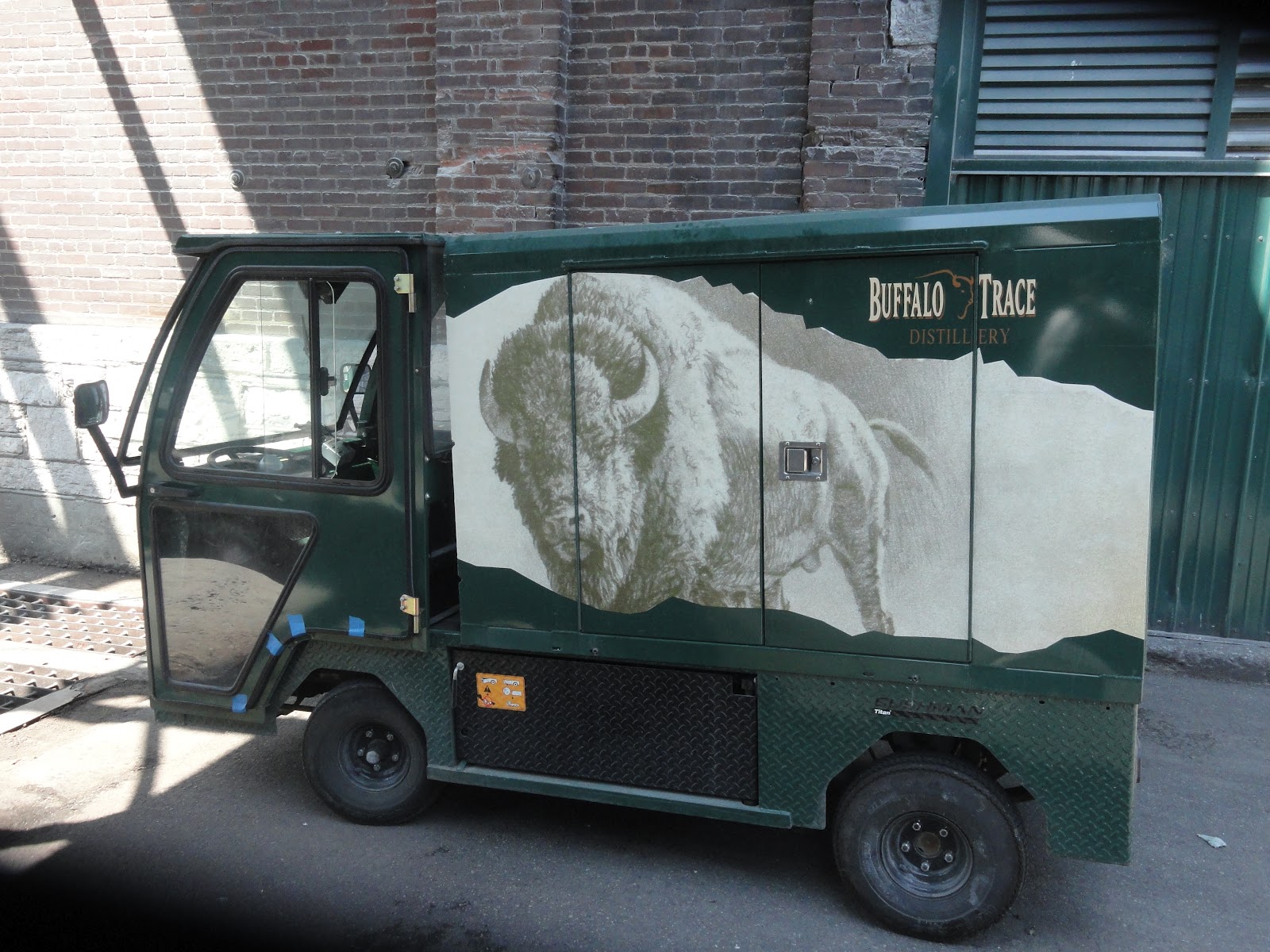
This cleverly designed mural is on the outside of one of the buildings, and it is interesting as it appears to move with you as you walk by it.

They have three stills, two of which are four stories high and located in the same building.

One of their buildings, three stories high, contains 10 large fermentation vats and they can ferment about 180,000 gallons per day.

Most of their equipment is geared to large scale production, thousands of gallons at a time. This allows them to produce sufficient product for 14 different brands.

They buy their yeast from Fermentis, based on their own formula, and they use that same yeast for all of their brands. They keep some of their yeast strain in five separate places so that it will never be lost.

We walked through the mash fermenter room, seeing lots of large tanks containing the mash, the bubbles in the mash caused by carbon dioxide. There is a "No Swimming" warning here, which could actually be a hazardous activity. They allowed us to taste some of the mash, which generally was very sweet.

I find it fascinating that Buffalo Trace has a special experimental program, where they produce small batches of bourbon, trying to alter all sorts of aspects of the production, testing various factors. The program began in 1989 and have tested items such as aging bourbon in fine grain, coarse grain, double barrels, with oak chips, French oak, and finished in barrels that once held Chardonnay, Zinfandel and Cabernet Franc. There are about 1000 barrels of bourbon currently in the program and some will eventually get released in the Buffalo Trace Experimental Collection label. Twenty products have so far been released under this label.

Since 2007, their experiments have been produced in a special micro-distillery, pictured above. This is a combination pot still/column still and can produce 1-10 barrels of bourbon, as opposed to previously when they had to make a minimum batch of 70 barrels. This allows them to conduct more experiments, and it is much more cost effective than producing the far larger amount. Innovation and experimentation are very important so Buffalo Trace deserves kudos for their program.

The distillery owns 12 warehouses, where approximately 320,000 barrels of bourbon are aging. We spent some time in Warehouse "C," which was originally constructed by Colonel E.H. Taylor Jr. in 1881. It holds about 24,000 barrels, separated by recipe and not brand, and the floorboards are still original. The walls are separated from the ricks so if the wall happens to collapse for any reason, the barrels will be fine. This has been beneficial when a terrible storm damaged the warehouse, yet the ricks remained secure.

Colonel E.H. Taylor Jr. once produced a bourbon named "Old Taylor" and in November 2009, Buffalo Trace decided to replicate this historical bourbon. They used the original recipe and it is currently aging in one of their warehouses. There is not a planned release date yet, as they will conduct periodic taste tests to determine when it is ready for release.

After the tour, we finished with a tasting of four of their products. First, was the Buffalo Trace Kentucky Straight Bourbon Whiskey, which is about 8-9 years old and 90 proof. I found it to be smooth, with plenty of spice notes, vanilla, mild caramel and hints of sweetness. Good for drinking on its own, or mixed in a cocktail. And at around $25, it is a good value too.

The Eagle Rare Single Barrel is about 10 years old and 90 proof. It was also silky smooth but spicier than the Buffalo Trace. Its flavors were more complex, a melange of caramel, almonds, honey, vanilla, and dried fruits. A lengthy and pleasing finish really satisfied my palate. It costs around $30 and it too is a very good value. This is definitely a bourbon I would prefer drinking neat, though it can enhance a cocktail as well.

One of the surprises of the tasting was the Buffalo Trace Bourbon Cream Liqueur. It resembles Bailey's Irish Cream, but I much prefer the Buffalo Trace. It is made with real cream and has a rich, creamy and sweet taste, just pure hedonistic pleasure. I even tried some mixed with some root beer, which was kind of like a float without the ice cream. Unfortunately, it is currently not sold outside of Kentucky, though I did buy a couple bottles while I was there.

A bourbon distillery making vodka? Yes, that seemed strange to me as well but Buffalo Trace seemed to think it worked well together. Their Rain Vodka is certified organic and is produced from 100% organic white corn. The use of corn does provide a link to their bourbon. They have a dedicated vodka still and this vodka is distilled seven times. It actually had an interesting taste, with a bit of sweetness, and was fairly smooth, enough that you probably could drink this alone on ice. I was not expecting it to taste as good as it did, and it is worthy of a recommendation.

They are working on another vodka, which they will name HDW CLIX. The HDW are the initials of their Master Distiller, Harlen Davis Wheatley. The CLIX is the Roman numeral for 159, which will be the number of times that the vodka is distilled. That is an incredible amount of distillations though I am not sure that many is really necessary or will accomplish anything. At some point, multiple distillations probably won't produce any noticeable changes. But I am intrigued to see the final product.

Buffalo Trace Distillery is a fascinating place and if you are in the area then you definitely should take one of their tours. The distillery has a firm foot in its historical past yet its other foot is firmly in the future, devoted to innovation and experimentation. They produce plenty of excellent bourbons and you should explore the various brands that they make, enjoying the diversity of flavor profiles.
Read More
Posted in bourbon, cocktails, distillery, kentucky, louisville, spirits, whiskey | No comments
Older Posts Home
Subscribe to: Posts (Atom)

Popular Posts

  • Taste Camp: The Wine Industry of Quebec (Part 1)
    Exploring emerging wine regions is always a fascinating endeavor even if their wines are not readily available outside of that region. It is...
  • Tuscan Market: One Stop Shopping & Cafe
    Many of us would love to be able to easily purchase fresh baked bread, fresh local produce, artisan cheese, meats, seafood, fresh pasta, win...
  • Rant: Beware The Self-Proclaimed Expert
    I am very tired of self-proclaimed wine experts, gurus, ninjas and whatever whose actual knowledge is lacking. This is obviously not a prob...
  • Rant: U.S. Sake vs Japan Sake--Context Is Everything
    Is sake produced in the U.S. as good as sake produced in Japan? Does the question require more specificity? Or is it even a fair question? A...
  • Rant: Where Is The Roast Chicken Love?
    1990 was a pivotal year in the battle of beef versus chicken . It was the first year that Americans ate more chicken than beef, and that has...
  • Boston Wine Expo: Pinotage Rosé to Cape Verde
    Here is a sampling of some of the other wines that I found interesting at the Boston Wine Expo , and I will be posting about even more wines...
  • Rant: Rushing To Judge A New Restaurant
    As soon as a hot, new restaurant opens, there is a rush for food bloggers and online reviewers to dine there and immediately report back. Ti...
  • International Boston Seafood Show: Fish Fun & Photos
    “ Fish is held out to be one of the greatest luxuries of the table and not only necessary, but even indispensable at all dinners where there...
  • Rant: Outraged By Sake Prices At Restaurants
    We often hear complaints about the outrageous prices  of wine sold at many restaurants. Some places charge three, four or even fives times t...
  • Rant: Post-Labor Day Wine Advice
    With today as Labor Day , it is seen by many people as a signal of the end of summer, despite the fact that the official end is not until Se...

Categories

  • 2011 (8)
  • 2012 (9)
  • 2013 (2)
  • alabama (1)
  • alaska (1)
  • alcohol (1)
  • allergy (1)
  • alsace (3)
  • Andover (3)
  • animal (1)
  • anniversary (1)
  • Argentina Wines (10)
  • Arlington (11)
  • armenia (1)
  • art (4)
  • Australia Wines (2)
  • austria wines (5)
  • author (12)
  • award (2)
  • Bacon (1)
  • Bakery (15)
  • bar (1)
  • bbq (3)
  • beauty (1)
  • Bedford (2)
  • beer (19)
  • biodynamic wine (1)
  • biography (1)
  • blogging (35)
  • Book reviews (30)
  • book store (3)
  • Boston (165)
  • bourbon (11)
  • braintree (2)
  • brazil wines (1)
  • brazilian (1)
  • breakfast (2)
  • brewery (6)
  • brighton (1)
  • Brookline (9)
  • brunch (15)
  • Burlington (3)
  • business (1)
  • butcher (4)
  • California Wines (20)
  • Cambridge (29)
  • canada (8)
  • Canada Wines (7)
  • candy (3)
  • cape cod (6)
  • cape verde wines (1)
  • casino (7)
  • caviar (1)
  • celebrity (2)
  • champagne (11)
  • Charity (33)
  • cheese (23)
  • chef (27)
  • chianti classico (10)
  • children (2)
  • Chile (2)
  • Chile Wines (2)
  • china (6)
  • chinatown (3)
  • chinese cuisine (8)
  • chocolate (1)
  • christmas (3)
  • cider (8)
  • cocktails (47)
  • colorado (2)
  • concord (10)
  • conference (9)
  • Connecticut (12)
  • consumers (2)
  • contest (8)
  • controversy (97)
  • cookbooks (5)
  • cooking (15)
  • cuba (1)
  • cyprus wines (1)
  • dance (1)
  • Danvers (2)
  • dessert wine (1)
  • desserts (21)
  • diet (2)
  • dining service (1)
  • discount (1)
  • distillery (14)
  • dlw13 (1)
  • donuts (1)
  • dorchester (16)
  • easter (6)
  • Eating Habits (2)
  • ebook (6)
  • ethics (3)
  • ethiopia (1)
  • farming (10)
  • father's day (1)
  • fiction (11)
  • finger lakes (2)
  • florida (1)
  • Food (4)
  • Food Event (8)
  • Food Market (12)
  • food news (2)
  • food processing (2)
  • food safety (4)
  • food truck (1)
  • France (3)
  • France Wines (19)
  • fruit (7)
  • Games (2)
  • gardening (1)
  • georgia wines (1)
  • gin (1)
  • glasses (1)
  • grapes (4)
  • Greece Wines (1)
  • guest post (1)
  • health (21)
  • history (34)
  • holiday (46)
  • hotel (2)
  • Hungary Wines (3)
  • hybrid (2)
  • ibss12 (14)
  • ibss13 (13)
  • Ice Cream (5)
  • ice wine (2)
  • iceland (1)
  • interview (5)
  • ipswich (4)
  • ireland (2)
  • italian cuisine (43)
  • Italy (19)
  • Italy Wines (38)
  • jamaica plain (1)
  • japanese (70)
  • kentucky (12)
  • korea (1)
  • law (13)
  • legend (9)
  • lincoln (6)
  • liqueur (1)
  • local wine (2)
  • los angeles (1)
  • louisiana (2)
  • louisville (7)
  • lynnfield (1)
  • madeira (1)
  • magazine (16)
  • Maine (2)
  • Malbec (1)
  • Malden (1)
  • mallorca (1)
  • mardi gras (2)
  • Massachusetts (4)
  • Massachusetts Wines (6)
  • mead (5)
  • meat (23)
  • Medford (6)
  • melrose (3)
  • mexican cuisine (16)
  • mexico wine (3)
  • mezcal (1)
  • milk (2)
  • milton (1)
  • mississippi (1)
  • montreal (2)
  • mothers day (1)
  • music (4)
  • natick (1)
  • needham (3)
  • new england (2)
  • New Hampshire (17)
  • new year's eve (10)
  • New York (3)
  • New York City (3)
  • New York wines (1)
  • New Zealand Wines (1)
  • newburyport (1)
  • newport (1)
  • news (1)
  • newspaper (7)
  • newton (9)
  • North Andover (16)
  • north end (12)
  • nova scotia (5)
  • Oregon (2)
  • Oregon Wines (6)
  • organic food (1)
  • organic wine (2)
  • paso robles (3)
  • peruvian cuisine (1)
  • phillipines (2)
  • pinotage (2)
  • pisco (1)
  • Pizza (2)
  • pork (3)
  • port (13)
  • portland (1)
  • portsmouth (6)
  • Portugal (6)
  • Portugal Wines (19)
  • poultry (1)
  • providence (1)
  • provincetown (5)
  • quebec (5)
  • rant (97)
  • Reading (1)
  • Recipe (11)
  • Restaurant (198)
  • restaurant going (8)
  • restaurant reviews (65)
  • Rhode island (4)
  • rose (7)
  • rum (11)
  • Sake (61)
  • Sake Reviews (15)
  • salem (2)
  • salmon (4)
  • sandwich (5)
  • science (10)
  • scotland (4)
  • seafood (72)
  • Seattle (1)
  • sherry (10)
  • shochu (1)
  • shopping (3)
  • social media (1)
  • soda (2)
  • Somerville (13)
  • South Africa Wines (7)
  • spain (8)
  • Spain Wines (18)
  • sparkling wines (6)
  • spirits (42)
  • sports (4)
  • st. patrick's day (4)
  • steakhouse (12)
  • sudbury (1)
  • sushi (5)
  • sustainability (61)
  • sweden (1)
  • tastecamp (5)
  • tea (6)
  • television (4)
  • tequila (2)
  • texas (1)
  • thai (2)
  • thanksgiving (9)
  • theater (2)
  • top ten (14)
  • toronto (1)
  • travel (8)
  • twitter (1)
  • united states (1)
  • Uruguay Wines (1)
  • valentine's day (5)
  • vegetables (3)
  • vermont (4)
  • virginia (1)
  • virginia wines (1)
  • vodka (8)
  • Wakefield (1)
  • walpole (2)
  • watertown (1)
  • wayland (1)
  • wbc (3)
  • west concord (1)
  • westwood (1)
  • whiskey (19)
  • Winchester (14)
  • Wine (3)
  • Wine Education (19)
  • wine event (14)
  • wine importers (1)
  • wine marketing (11)
  • Wine news (3)
  • wine pairings (15)
  • wine personality (1)
  • Wine Prices (5)
  • Wine Reviews (68)
  • wine sales (13)
  • Wine Stores (23)
  • Wine tasting (11)
  • wine writing (1)
  • winemaker (4)
  • winemaking (6)
  • wineries (5)
  • winery (21)
  • Woburn (3)
  • women (3)

Blog Archive

  • ▼  2013 (171)
    • ▼  September (5)
      • Why Are You Fat?
      • Thursday Sips & Nibbles
      • Heirloom Flavor: From a Dragon's Tongue to a Nebra...
      • Papa's Pilar Rum: What Would Hemingway Do?
      • Rant: Post-Labor Day Wine Advice
    • ►  August (19)
    • ►  July (18)
    • ►  June (19)
    • ►  May (19)
    • ►  April (20)
    • ►  March (32)
    • ►  February (20)
    • ►  January (19)
  • ►  2012 (283)
    • ►  December (21)
    • ►  November (23)
    • ►  October (30)
    • ►  September (17)
    • ►  August (26)
    • ►  July (23)
    • ►  June (19)
    • ►  May (21)
    • ►  April (20)
    • ►  March (34)
    • ►  February (26)
    • ►  January (23)
  • ►  2011 (46)
    • ►  December (27)
    • ►  November (19)
Powered by Blogger.

About Me

Unknown
View my complete profile